




Rule O’Flaw is a social advocacy platform that publishes academic research, opinion articles, and intellectually grounded satire to expose corruption, human rights abuses, and persistent governance failures that conventional media often underplay or normalise. We examine issues affecting the rule of law, with particular attention to systemic flaws and biases shaping the administration of justice. We aim to motivate legal professionals and policymakers to recognise their responsibility to address these challenges.
We synthesise leading research on judicial bias, institutional design, and systemic failure to provide a coherent, evidence-based account of how legal systems malfunction in practice. We examine how cognitive psychology shapes judicial outcomes and entrenches systemic bias within legal institutions, showing how cognitive shortcuts and framing effects can distort legal reasoning and undermine fairness.
This integrated analysis offers a rigorous foundation for diagnosing deep institutional flaws and designing substantive, evidence-led reforms rather than superficial, cosmetic changes.
Developing Original Conceptual Frameworks
Our analyses rest on a deep engagement with first principles alongside a sophisticated command of contemporary scientific models and technological tools. This enables us to develop original conceptual frameworks that clarify complex phenomena, including how heuristic-driven cognitive biases shape institutional behaviour, media narratives, and public perception.
We explain why traditional safeguards—courts, oversight bodies, integrity agencies, and internal review mechanisms—so often fail to restrain government overreach. By mapping the structural weaknesses that enable authorities to bypass checks and balances, we show how public fiduciaries engage in corrupt conduct with impunity and how accountability measures can be reliably enforced.
Delivering Technology-Driven Forensic Insight
Our reporting is anchored in rigorous academic standards and context-rich narratives, enabling readers to situate contemporary controversies within their legal, historical, and institutional contexts. By integrating data analysis, modelling, and cross-disciplinary methods, we treat legal and political crises not as isolated scandals but as manifestations of broader, identifiable patterns.
These insights enable us to anticipate systemic failures, identify leverage points for reform, and challenge official accounts with carefully substantiated, empirically anchored alternatives.
Fostering Effective Public-Interest Advocacy
We provide a collaborative platform for collective action, enabling individuals to share experiences, contribute data, and participate in coordinated efforts to address entrenched government and institutional failures. This infrastructure turns isolated incidents into a cumulative evidence base that supports strategic litigation, targeted campaigns, and informed public debate.
We show how collective action, when paired with clear frameworks and data-driven advocacy, can confront government misconduct and institutional evasion of responsibility. Our platform offers resources, templates, and conceptual scaffolding to help people organise complaints, structure cases, and build durable advocacy networks for long-term structural change rather than symbolic gestures.
Our work rests on a central insight: systemic injustice is driven less by individual malice than by institutional design that fails to account for human cognitive limitations. By integrating empirical research in cognitive psychology with rigorous legal analysis, we offer legal professionals, policymakers, and the informed public a framework for understanding how bias becomes embedded in judicial institutions—and, crucially, how it can be remedied.
Rather than treating legal doctrine and human behaviour as separate domains, we demonstrate their profound interconnection. Our analysis reveals how cognitive shortcuts, institutional inertia, and structural impediments systematically undermine the rule of law.
This approach achieves three critical objectives:
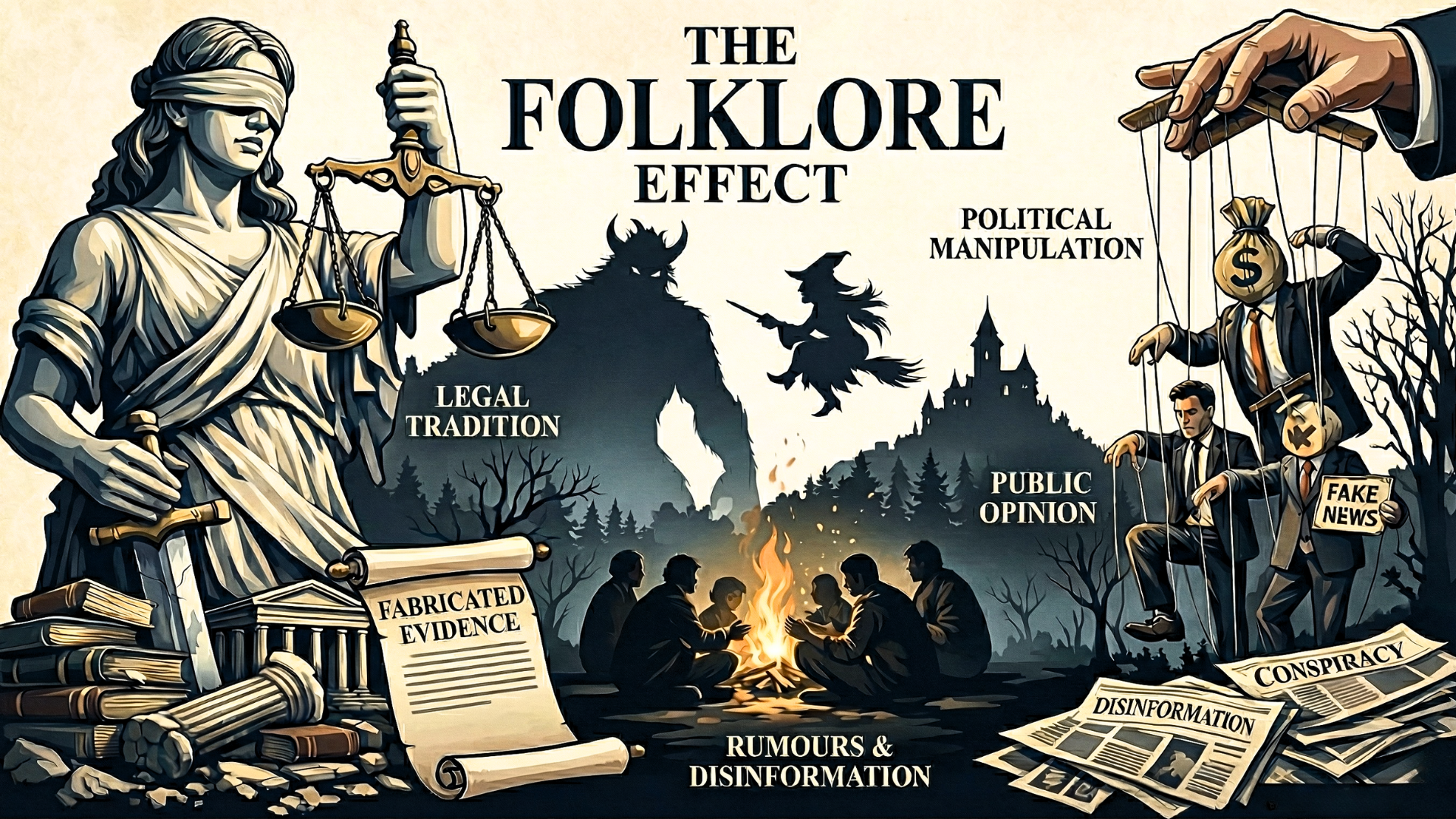
The “Folklore Effect” is a four-stage escalation model that explains how institutional actors respond to the exposure of error, leading to reputational panic, myth-making about dissenters, and sustained suppression of disconfirming evidence. Grounded in established academic principles—particularly Kahneman and Tversky’s prospect theory and the concept of moral hazard arising from judicial immunity—this framework is an original attempt to bridge cognitive science and legal theory. The model moves beyond simplistic “bad apples” narratives by explaining corruption as a structural, predictable emergent property of institutions populated by cognitively bounded agents.
By reframing judicial misconduct as a consequence of institutional design failures rather than individual moral shortcomings, the Folklore Effect offers a diagnostic tool that could, in principle, inform meaningful structural reform. Its emphasis on loss aversion driving officials toward self-protective misconduct—especially when combined with judicial immunity—is both theoretically coherent and intuitively compelling.
Through the development and wider publicisation of the Folklore Effect, we aim to advance three critical objectives: