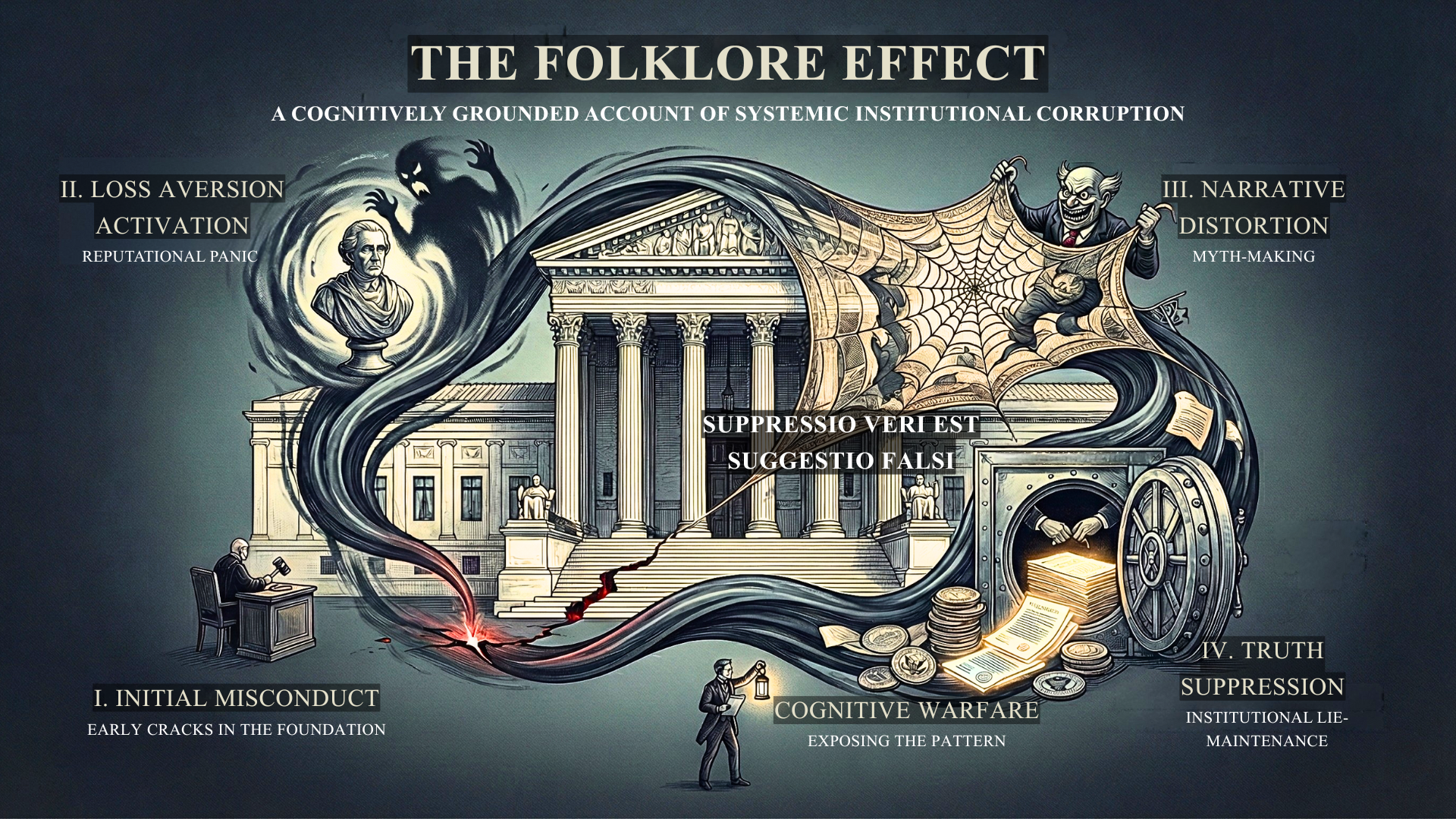





In this 37‑minute conversation, Shivesh and Peter share key insights from their journey as judicial reform activists and explain how cognitive science exposes systemic corruption in contemporary judicial systems. Below is an overview of the essential issues covered in the discussion.
I. Introduction
This discussion between Shivesh and Peter about the motivation for establishing Rule O’Flaw offers a sustained critique of how contemporary legal institutions structurally incentivise corruption and procedural bad faith. It presents public interest litigation as an experimental project in “auditing” those institutions, rather than merely defending private rights. The central claim is that the rule of law, as currently practised, embeds systemic predation on vulnerable defendants and litigants, while insulating judges, regulators, and government lawyers from meaningful accountability.
II. Core Thesis and Normative Stance
Shivesh’s core thesis is that legal institutions possess a noble normative architecture but are implemented through professional cultures and procedures that, in practice, predictably corrupt that architecture. Public interest litigation is thus reconceptualised as a laboratory for stress‑testing legal systems and developing techniques—organisational, technological, and psychological—to discipline institutional actors who exploit those systemic flaws.
From a normative perspective, the position is unapologetically de‑romanticising of legal practice. Law is defended as an abstract system of logic, argument and rights adjudication, but legal professions are condemned for commodifying truth and justice into transactional bargaining chips. This creates a structural tension: those most dependent on the law for protection are also those most likely to be targeted by its predatory aspects, particularly where they challenge entrenched state or professional power.
III. Cognitive Psychology, Institutional Design and Corruption
A sustained theme is the attempt to ground institutional critique in cognitive psychology and behavioural regularities rather than moralised anecdote. Shivesh treats corruption not as an aberration but as a predictable emergent property of institutions populated by agents with bounded rationality, self‑interest, status anxiety, and aversion to shame.
Key moves include:
- Treating human behavioural propensities (risk aversion, herd behaviour, careerism, preference for convenience over principle) as parameters that can be “designed around” in institutional architecture.
- Arguing that legal procedure has evolved path‑dependently to enable sophisticated actors—governments, regulators, large firms—to arbitrage these propensities in less powerful counterparts (e.g. hourly workers, migrants, small businesses) via delay, cost, and psychological pressure.
- Drawing explicitly on the institutional economics of corruption (for example, contemporary scholarship on “benevolent entrepreneurs” and Johann Lambsdorff’s work on the “invisible boot” of the market) to justify strategies that pit corrupt actors’ interests against each other, induce betrayal within corrupt networks, and weaponise transparency and shame as regulatory tools.
The discourse, therefore, invites a progressive legal audience to shift from deontological condemnations of “bad apples” to a systemic analysis of incentive structures, feedback loops, and “corruption‑enabling” design choices in courts, regulators, and prosecutorial offices.
IV. Access to Justice, Plea Dynamics and Procedural Predation
One of the most concrete contributions of the discussion to rule‑of‑law scholarship is its granular account of how access to justice is structurally undermined by costs, delays, and prosecutorial bargaining, particularly for precarious defendants. The account links individual experience to a broader indictment of plea‑driven justice:
- Prosecutorial success metrics (e.g. 80% conviction rates) are described as being achieved by exploiting the economic vulnerability of defendants whose income is contingent on daily attendance at casual work, making them highly sensitive to repeated court dates and legal fees.
- The practice of offering a plea to a “lesser” but still consequential charge (for example, in a traffic accident scenario involving a student visa holder) is characterised as a coercive transaction cloaked in procedural legitimacy: defendants are invited to trade away truth and contestation to avoid catastrophic immigration or custodial consequences.
- Defence practitioners are portrayed as structurally co‑opted into this ecosystem, advising guilty pleas on cost‑benefit grounds even where viable factual defences exist, thereby normalising the conversion of innocence into administratively convenient guilt.
This is reframed as institutionalised extortion: the state leverages process costs and downstream consequences to manufacture consent for conviction. The concept of “predatory systems” here aligns with critical scholarship on plea bargaining, but the account is enriched by first‑hand narrative and by an explicit link to corruption research: the system’s stability depends on the routinisation of small injustices that rarely reach appellate scrutiny.
V. Professional Intimacy, Adversarial Theory and Conflicted Loyalties
The discussion also interrogates the sociological dimension of legal practice, particularly the normalisation of collegial intimacy between defence and prosecution and between bench and bar. For an audience steeped in adversarial theory, the critique is pointed:
- The habitual use of terms such as “my friend” between opponents is presented not as harmless etiquette but as a signal of shared professional identity that may temper rigorous contestation, especially where the client is an outsider (migrant, working‑class defendant, political dissident).
- Friendship and repeat‑player dynamics are said to generate a latent conflict between practitioners’ obligation to their client and their incentives to preserve professional relationships, reputations, and courtroom “peace”.
This critique intersects with established concerns about “club government” in the judiciary and bar. Still, it goes further, asserting that state actors knowingly exploit these relational economies to manage dissent and isolate disruptive litigants who refuse to show deference or civility. Shivesh’s refusal to extend courtesy to officials perceived as acting in bad faith is explicitly framed as a strategic rejection of complicity in what is described as an ongoing “fraud on the court”.
VI. Judicial Discretion, Immunity and the “Noble Heart, Wicked Mind” Paradox
A central theoretical motif is the paradoxical characterisation of law as having a “noble heart” but a “wicked mind”. This captures the disjunction between the aspirational principles enshrined in doctrines and legislation, and the manner in which those principles are operationalised through discretionary decision‑making.
Several doctrinal and institutional targets are implicated:
- Civil procedure reforms, ostensibly aimed at curbing delay and tactical obstruction, are said to have been inverted: the very actors they were meant to discipline now invoke “expedition” and “proportionality” to shut down meritorious but inconvenient claims, especially when brought against government or powerful corporate defendants.
- Judicial discretion is characterised—echoing Grant Donaldson’s writing—as an “abused term”, invoked as a rhetorical shield for outcomes that cannot be convincingly justified in principle.
- Judicial immunity is rejected as both conceptually and empirically indefensible. If judges are fundamentally ordinary human agents subject to the same cognitive biases and temptations as others, then the absence of personal legal accountability is framed as an invitation to abuse rather than a guarantee of independence.
The discussion of a judge, Justice James Gorton (of the Supreme Court of Victoria), who seemingly complained about the litigant to a regulator, in circumstances amounting to a de facto ex parte communication, serves as an illustrative case study of how formal and informal power can be combined to discipline critics of judicial performance. For a rule‑of‑law audience, the implication is stark: when judges can use regulatory machinery against litigants who embarrass them, the ideal of neutral adjudication collapses into a system of reputational and professional reprisals.
VII. Technological Adjudication, Algorithmic Justice and Human Idealism
The discussion advances a provocative, deliberately hyperbolic thought experiment: the “ideal” justice system would, from a probabilistic standpoint, insert electrodes into parties’ brains, extract relevant information, and feed it to an algorithm that mechanically applies law. This serves several analytic purposes:
- It exposes the degree to which current systems tolerate enormous cost, delay, and error while fetishising humanistic rituals (oral advocacy, judicial demeanour) that do little to improve epistemic accuracy.
- It highlights the commodification of legal process: removing lawyers from the system in favour of algorithmic adjudication is described as a rational response to the profession’s transformation of rights into billable opportunities.
Yet the position stops short of full techno‑legalism. Shivesh insists that humans must remain involved in judging because they embody aspiration, creativity, and the capacity to evolve doctrine in response to novel injustice—capacities that rigid software, trained only on existing law, cannot replicate. At the same time, most current judges are said to add negative value by misusing civil procedure as an instrument of expedient injustice. Shivesh suggests a literal coin toss would be preferable, as it would at least not systematically privilege power.
An additional speculative frontier raised is the use of biometric monitoring and AI‑assisted analysis of judicial behaviour (e.g. “spatial thermometers” to track physiological states) to detect deceit, bias or bad faith in real time. This is justified on the basis that judges exercise life‑altering power and therefore should be subjected to transparency and scrutiny more intensive than that applied to average citizens.
VIII. Shame, Accountability and the Ethics of “Benevolent Entrepreneurship”
A distinctive conceptual contribution is elevating shame from a moral emotion to a central regulatory instrument. Shivesh conceptualises shame as an evolutionary mechanism that deters short‑term, self‑serving conduct that threatens long‑term social standing and cooperation.
This is developed along several lines:
- Shame is deliberately deployed against public officials, judges, and government lawyers who are perceived to be abusing power, to make their professional lives as stressful and precarious as those of ordinary offenders and litigants they target.
- The project is explicitly situated within Lambsdorff’s framework of “benevolent entrepreneurs” who design systems and technologies that create conflicts of interest within corrupt networks, incentivising whistleblowing, betrayal, and disclosure.
- Litigation, media exposure, and strategic non‑compliance (e.g. strict, non‑conciliatory insistence on procedural rights designed to provoke unlawful overreach) are described as tools in an “audit” of the system, generating empirical data about how institutions respond when their informal power is challenged.
The ethical ambivalence of this strategy is acknowledged in the discussion of “personal shame”: Shivesh enjoys high‑stakes conflict and derives meaning from confronting systemic corruption, but recognises that this imposes collateral costs on family, supporters, and associates who did not consent to the risks. This tension between political necessity and personal cost will resonate with audiences concerned with the ethics of resistance in the face of institutional decay.
IX. Public Interest Litigation as Systemic Experimentation
For an audience focused on the rule of law, one of the most significant moves is the explicit rejection of conventional client‑centred advocacy in favour of cause‑driven, system‑oriented litigation. Several features are noteworthy:
- Litigation is framed as a research method. Each case is an experiment designed to test hypotheses about how institutions behave under stress, how corrupt actors adapt, and where doctrinal or procedural leverage can be found.
- Shivesh’s businesses are described as structured around rigid, rule‑based protocols that deliberately minimise human discretion, precisely so that deviations and institutional responses can be attributed to external actors rather than internal inconsistency.
- Engagements with regulators such as the Victorian Legal Services Board are characterised as extensions of this project. By being overtly inflexible and legally exacting, the litigant invites retaliatory overreach that can then be documented and contested to reveal patterns of malicious abuse of authority.
Crucially, the goal is not only personal vindication. Shivesh anticipates that, “when the dust settles”, a corpus of precedents and documented episodes will emerge that others can use to constrain future abuses and reshape legal doctrine, particularly in civil procedure, regulatory powers, and judicial accountability.
X. Implications for Progressive Rule‑of‑Law Scholarship
For a progressive, professionally literate audience, the issues raised in the discussion invite several lines of further inquiry and debate:
- How should left‑leaning legal theory respond to an account of the justice system in which systemic predation is not an accidental by‑product of capitalism but a consciously maintained equilibrium serving institutional convenience and bureaucratic self‑preservation?
- What forms of judicial accountability—civil liability, disciplinary transparency, biometric monitoring, algorithmic audit—are compatible with both the protection of rights and the maintenance of judicial independence, once naive faith in judicial virtue is abandoned?
- To what extent can “benevolent entrepreneurship” and market‑based anti‑corruption tools be reconciled with scepticism about neoliberal governance, and how can they be deployed without reproducing existing inequalities in access to technological and financial resources?
- How should legal ethics and professional regulation respond to the critique of collegial intimacy and plea‑driven convenience as structurally corrupting forces in adversarial systems?
The discussion thus functions less as a personal narrative and more as an invitation to reconceive public interest litigation as a form of systemic experimentation against entrenched corruption, using law, technology, and psychological insight not only to win cases but to re‑engineer the conditions under which law can credibly claim to uphold the rule of law.