




I. Introduction
The classical conception of justice rests on a foundational myth: that judges function as impartial logic engines, mechanically processing facts and law to produce inevitable, rationally justified verdicts. This framework of “mechanical jurisprudence,” in which judicial reasoning follows a deterministic path from factual input to legal output, has long anchored public confidence in the rule of law. Yet mounting cognitive science research reveals a starkly different reality. Rather than operating as formal logical systems, judicial minds function as coherence engines, dynamically adjusting networks of competing arguments, evidence, and legal principles until they settle into a subjectively unified narrative. This fundamental cognitive architecture, while not inherently pathological, creates systemic vulnerabilities that can be exploited by deliberate actors. When coupled with judicial discretion—the legitimate authority to make consequential decisions involving valuable benefits and serious costs—these cognitive mechanisms transform from unavoidable human limitations into actionable vectors for corruption and manipulation.
Understanding this connection between judicial cognition and systemic corruption requires moving beyond the traditional focus on individual moral failings. Instead, it demands recognition that cognitive architecture itself creates the preconditions for both unintentional bias and deliberate subversion. The question facing democratic societies is not whether judges can somehow achieve superhuman objectivity, but how institutional design can account for the coherence-seeking mind while maintaining legitimacy and predictability in legal outcomes.
II. The Myth of Mechanical Jurisprudence and the Reality of Cognitive Processing
A. From Logic Engine to Coherence Engine
The image of judicial reasoning as a deterministic process—facts in, law applied, verdict out—exerts a powerful influence on how courts present themselves and how the public understands the legitimacy of judgment. This mythology is actively reinforced through judicial opinion writing, which employs a rhetorical style that suggests inevitability and certainty, as though the conclusion were foreordained by pure logic. Such styling obscures what cognitive science has empirically demonstrated: judges are not logic engines but coherence engines.
The coherence engine model describes a decision-making process fundamentally different from formal logic. Rather than following a sequential, step-by-step logical proof, the mind employs constraint satisfaction, a process in which all competing arguments, evidence, legal precedents, and hypothetical outcomes are treated as an interconnected web. The cognitive goal is not to identify a single logically correct answer, but to shift and adjust the entire network until it settles into a state of maximum coherence, where all elements appear to point in the same direction.
This reframing has profound implications. In a complex legal case presenting multiple interpretations of fact and law, the coherence engine does not systematically privilege legal arguments over others. Rather, it permits mutually exclusive narratives to each achieve internal coherence. The same set of facts and legal authorities can, with a “mental shift,” resolve into a perfectly coherent case for the plaintiff or, with another shift, for the defendant. The Necker cube optical illusion provides an apt analogy: just as the observer’s perception can flip between two equally valid three-dimensional interpretations of the same visual input, a judge can perceive two equally coherent but contradictory narratives within the same legal record.
B. The Certainty Manufacturing Process
Crucially, the coherence‑settling process produces what might be called manufactured certainty. As the cognitive network reaches maximum coherence, the subjective ambiguity that previously characterised the decision-making process vanishes. The selected outcome comes to feel obvious, inevitable, and uniquely justified, despite the equally valid competing narrative remaining cognitively available through a different configuration of the same elements. This phenomenon is particularly insidious because it creates the subjective experience of logical necessity while the underlying process is one of narrative integration rather than deductive proof.
This cognitive reality directly undermines the legitimacy claims embedded in mechanical jurisprudence. If judicial reasoning were truly logic-based, multiple equally coherent narratives should not be cognitively possible from identical inputs. Yet empirical observation suggests that precisely this situation characterises many consequential cases, particularly those involving ambiguous statutory language, conflicts between precedents, or factual disputes. The judge’s experience of certainty, therefore, reflects not logical compulsion but the achievement of narrative coherence—a distinctly different phenomenon.
III. Cognitive Biases as Systemic Vulnerabilities
A. Documented Patterns of Judicial Bias
While the coherence engine model describes normal cognitive function, judges do not exercise this function in isolation from cognitive biases that affect all human decision-makers. Decades of psychological research have empirically established that judicial minds are not immune to the same cognitive distortions that influence ordinary reasoning. Professional training and institutional position do not confer superhuman cognitive resilience.
The anchoring effect provides a particularly instructive example. In a landmark empirical study, federal judges received identical personal injury cases but with a critical variation. The control group proceeded directly to determining damages. The experimental group first ruled on a meritless motion to dismiss based on a $75,000 jurisdictional minimum—a figure entirely irrelevant for calculating appropriate damages and one that the judges themselves recognised as legally meaningless. Despite this explicit awareness of irrelevance, exposure to the $75,000 anchor produced a staggering effect: judges in the experimental group awarded an average of $350,000 less in damages than controls, representing a nearly 30% reduction triggered entirely by a figure the judges themselves had ruled legally immaterial.
This finding reveals the coherence engine’s vulnerability to arbitrary numerical inputs. Even when consciously aware of inappropriateness, the mechanism still incorporates extraneous information into its web of constraints. The cognitive system latches onto the anchor not through logical reasoning but through the weight‑adjusting process characteristic of constraint satisfaction. Lower anchors reduce the outcome estimate not because the judge rationally concluded damages should be lower, but because the coherence network integrated the anchor point, weighted subsequent arguments relatively lower, and settled into a more conservative overall configuration.
B. Inadmissible Evidence and the “Unringing the Bell” Problem
A second pervasive vulnerability concerns judicial capacity actually to disregard evidence they have officially ruled inadmissible. The popular conception imagines that once a judge rules evidence inadmissible, they can simply “unring the bell” and completely exclude it from consideration. Empirical research demonstrates this conception is false. Hearing prejudicial evidence—for example, a prior criminal conviction—influences judicial judgment even after explicit rulings to exclude it from consideration. The coherence engine, having incorporated information into its network, cannot fully excise it. Rather, the attempt to exclude merely reweights it; the information remains as a constraint on the overall network as it seeks coherence.
This vulnerability is particularly acute in multi-step proceedings where judges rule on preliminary matters involving specific evidence. A judge may, for instance, rule that a defendant’s prior conviction cannot be used to impeach credibility. Yet that conviction has already been introduced into the cognitive system. The subsequent rulings and verdicts emerge from a coherence network that includes this information as a constraint, even though explicitly weighted as impermissible. The coherence engine does not permit clean excision of knowledge; it allows only reweighting.
C. Hindsight Bias and Predictability Distortion
A third documented bias affecting judicial reasoning is hindsight bias. Once a judge knows how events actually transpired, they systematically overestimate how predictable that outcome was from the starting point. This bias is particularly problematic in cases requiring judges to assess what was foreseeable or what risks were apparent at an earlier decision point. Expert conduct cases, maritime collisions, professional liability claims, and other matters turning on reasonable foreseeability are all vulnerable to this distortion.
A judge who now knows that a particular event occurred—an accident, a default, a market collapse—will tend to assign much higher probability to that outcome having been foreseeable to the relevant actor at the earlier time, compared to what the actor could have actually anticipated. This creates systematic bias in favour of liability findings in hindsight‑bias‑susceptible cases, as judges unconsciously inflate the historical predictability of events they now know occurred.
D. The Systemic Implications of Recognised Vulnerabilities
These documented biases are not isolated curiosities for academic psychology journals. They create actionable vulnerabilities in the justice system. Because judges themselves typically remain unaware of when these biases influence their reasoning—the coherence engine operates largely outside conscious awareness—they cannot internally correct for identified vulnerabilities. A judge who knows intellectually that anchoring effects exist will not thereby prevent those effects from influencing their own decision-making. The processing occurs beneath the threshold of conscious control.
Moreover, the universality of these biases across the judicial population creates predictable patterns. If research demonstrates that exposure to a $75,000 anchor reduces average damage awards by 30%, this becomes actionable knowledge for parties seeking to influence judicial decisions. The vulnerability is not individual but systemic, reflecting how judicial minds function universally.
IV. From Cognitive Bias to Deliberate Manipulation: The Corruption Connection
A. Judicial Discretion as the Enabling Condition
The transition from describing inevitable cognitive limitations to analysing corruption requires understanding the role of judicial discretion. Public officials, including judges, possess the authority to distribute valuable benefits and impose high costs. This discretionary power—the mental leeway to exercise judgment in consequential matters—creates the structural precondition for corruption. Without discretion, there is nothing to corrupt. With discretion, incentive payments (bribes) become mechanisms for directing the coherence‑seeking mind toward particular outcomes.
A judge accepting a bribe does not thereby cease to function as a coherence engine. Instead, the bribe operates as an additional constraint within the cognitive network. The judge’s mind still seeks maximum coherence, still weighs competing arguments, still settles on a narrative that feels inevitable and just. But the coherence engine now operates within a constraint space that includes the bribe‑giver’s preferred outcome as a weighted preference. Corruption typically does not require a judge to knowingly disregard evidence or law. Instead, it operates by subtly shifting how the coherence engine weights the elements, influences which sources of authority receive prominence, and determines which narratives achieve the subjective experience of inevitability.
B. Exploiting the Architecture: From Individual Corruption to Systemic Manipulation
Understanding corruption through the lens of the coherence engine reveals why traditional anti-corruption interventions often prove insufficient. Rules against bribery, disclosure requirements, and increased monitoring and enforcement are all necessary. Yet they address corruption primarily as a moral or volitional problem (the judge choosing to be corrupt) rather than as an architectural problem (the cognitive system being inherently navigable).
Once the coherence engine architecture is understood, its mechanisms can be exploited through means short of traditional bribery. Strategic sequencing of arguments, careful selection of which precedents to emphasise, framing effects in case presentation, and even subtle priming through juxtaposition all operate on the coherence engine, guiding the network toward particular configurations without necessarily involving explicit quid pro quo arrangements.
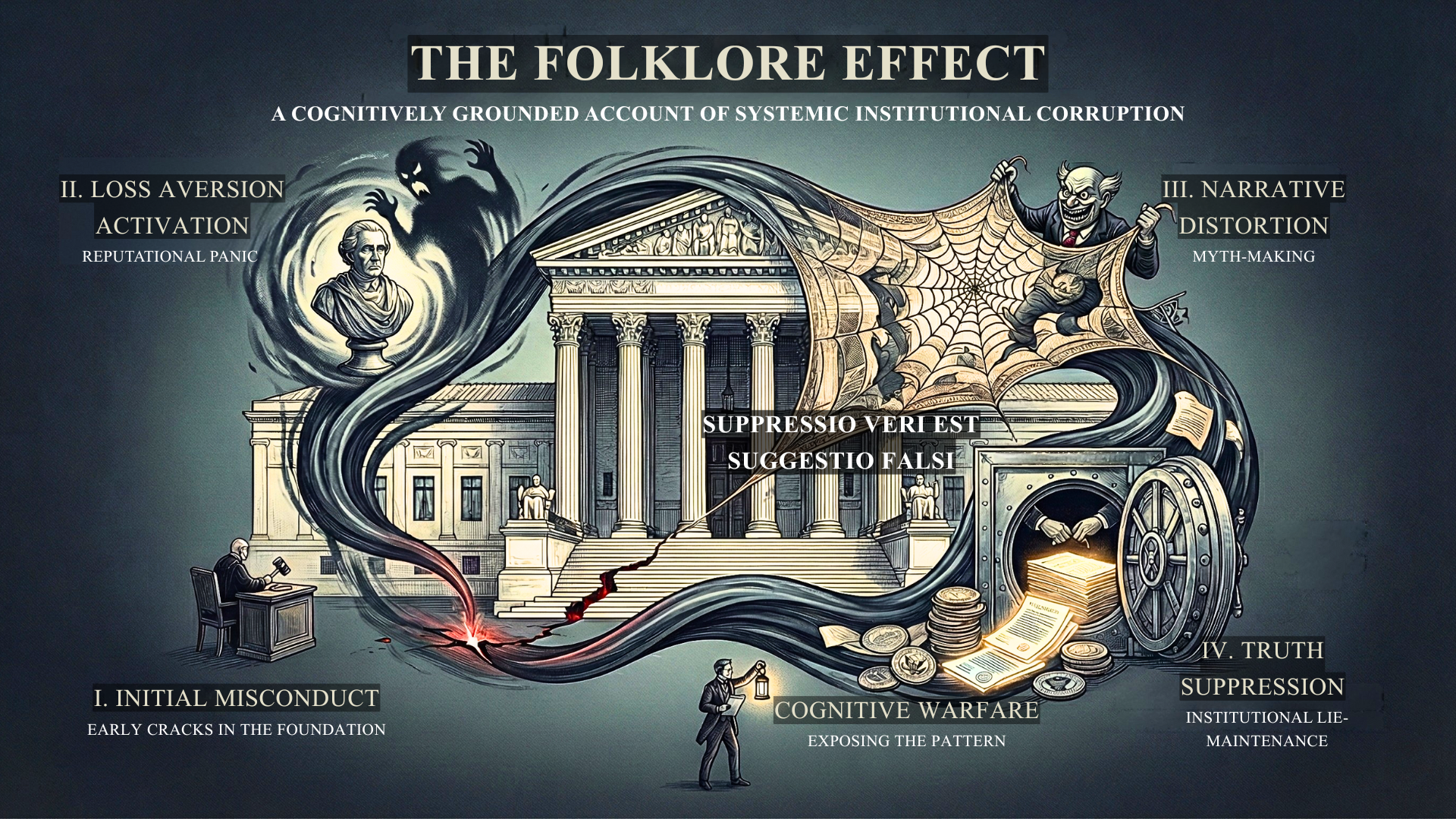
This observation extends to larger-scale phenomena. Modern cognitive warfare—the deliberate exploitation of cognitive processes to disrupt decision-making and gain strategic advantage—applies these principles across entire populations and decision-making institutions. From this perspective, judicial systems can be subjected to coordinated cognitive warfare in which the coherence engines of multiple judges are systematically influenced toward outcomes serving particular interests, through mechanisms that leave no obvious trace of traditional corruption.
V. Systemic Vulnerabilities and Institutional Failures
A. The Gap Between Ideal and Reality in Judicial Systems
The discussion thus far has sketched a troubling picture: judges function through cognitive mechanisms that are universal, largely unconscious, and vulnerable to both unintentional bias and deliberate manipulation. This raises a fundamental question for systems of justice that depend on the rule of law: if those entrusted with critical decisions are subject to deep-seated cognitive illusions and vulnerabilities, can we maintain genuine confidence in the system?
The question cannot be answered with simple optimism or pessimism. The system is not entirely defenceless. Institutional design has evolved various “software patches”—checks and balances intended to mitigate cognitive vulnerabilities. Appellate review, jury trials, written opinions requiring justification, recusal requirements, ethics rules, and institutional oversight all represent attempts to compensate for known judicial limitations.
Yet these patches are often imperfect. Appellate courts themselves consist of judges with identical cognitive architectures. Jury trial availability has declined dramatically in most jurisdictions. Written opinion requirements, while creating accountability, also reinforce the false narrative of mechanical jurisprudence by employing language suggesting foregone conclusions. Recusal rules sometimes permit judges to assess their own impartiality—the very bias they may lack the capacity to detect. And institutional oversight, which depends on detecting patterns across numerous decisions, often lags behind sophisticated actors learning to exploit the system in ways difficult to identify as systematic corruption.
B. The Rule of Law Legitimacy Crisis
A deeper problem emerges at the systemic level. Rule of law legitimacy depends partly on predictability and consistency: the sense that like cases will be decided alike, and that law, rather than the judge’s personal preference, determines outcomes. Yet if judicial minds are coherence engines capable of supporting multiple equally coherent narratives from identical inputs, predictability is fundamentally compromised by the cognitive network’s initial configuration, which depends on subtle factors such as case presentation, psychological priming, and the judge’s initial exposure to materials that may themselves have no formal relevance.
This is not to say that outcomes are completely arbitrary or that law plays no role. Instead, the coherence engine model suggests that law is one constraint among many in the network, and that the final settlement point depends on how multiple constraints interact. Law provides strong constraints but not always determinative ones in close cases.
Moreover, if this architecture is widely understood, public confidence may erode not from particular cases perceived as unjust, but from recognition that the system inherently rests on cognitive processes that cannot guarantee the certainty and consistency that rule-of-law legitimacy claims to offer. The gap between the myth of mechanical jurisprudence and the reality of coherence engines becomes a legitimacy problem, not merely a theoretical problem.
C. Corruption as Symptomatic of Architectural Vulnerability
Viewed from this perspective, corruption is not simply an aberration or breakdown in the system. Instead, it is the predictable exploitation of architectural vulnerabilities inherent in how judicial minds function. Well-designed institutions can make such exploitation difficult and detectable, but cannot eliminate the underlying vulnerability without fundamentally changing how judicial reasoning operates.
This creates a paradox: transparency about judicial cognitive architecture may increase corruption risk in the short term, as actors learn to exploit known vulnerabilities more systematically, before institutional responses develop. Yet sustained opacity about these vulnerabilities also undermines legitimacy and permits corruption to flourish unrecognised.
VI. Toward Institutional Responses: Beyond the Myth
A. The Necessity of Honest Epistemology
If confidence in the rule of law is to survive recognition of these realities, it must be founded on an honest accounting of how judicial minds actually function, rather than on maintenance of a comforting but false mythology. A perfect, infallible machine does not hand down justice; instead, justice emerges from the work of fallible human minds with all their biases and shortcuts, constantly trying to build coherent narratives from chaotic factual and legal material. This is the actual character of the judicial process.
Acknowledging this reality does not require abandoning rule-of-law ideals. Instead, it requires reframing those ideals away from the illusion of mechanical certainty and toward aspirational standards appropriate to human cognition: judges should strive for consistency, transparency, self-awareness about bias, willingness to revise, and accountability for patterns in their decision-making. Law should constrain and guide judicial cognition, even if it cannot completely determine outcomes in close cases.
B. Redesigning for Honest Cognition
Several institutional implications follow from taking judicial cognitive architecture seriously:
- Procedural protections must account for the dynamics of coherence engines. Safeguards against anchoring effects include limiting the sequencing of arguments and numerical inputs in particular ways. Protections against the influence of inadmissible evidence may require cognitive distance (temporal separation, different proceedings) rather than relying on judges to “unring the bell.” Awareness of hindsight bias might warrant a more cautious approach in foreseeability cases.
- Opacity about cognitive biases should be reduced through systematic training. Judges should understand not merely that biases exist in the abstract, but how the coherence engine specifically functions and which vulnerabilities attach to particular case types. Self-knowledge cannot eliminate biases but can reduce unconscious reliance on heuristics.
- Appellate review should incorporate pattern analysis. Single cases reviewed on appeal tell us little about whether a particular judge has had their coherence engine systematically navigated toward specific outcomes. Patterns across numerous cases—analysed to determine whether particular judges consistently favour certain parties or rule differently on similar facts depending on subtle variations in case presentation—might reveal systematic bias or manipulation.
- Jury trial availability should be preserved and, where possible, expanded. Lay jurors, while subject to their own cognitive biases, bring cognitive diversity and may be less vulnerable to systematic manipulation than judges with specialised legal training and established decision-making patterns. The shift toward judge-decided cases may exacerbate corruption vulnerabilities.
C. The Essential Feature or Fatal Flaw Question
The analysis ultimately confronts a philosophical question: is the very human, coherence‑seeking process by which judges reach decisions ultimately a flaw in the system of justice, or an essential feature?
The answer is neither simple affirmation nor negation. The coherence engine is neither a flaw that can be engineered away nor a feature that should be embraced uncritically. It is the inescapable character of human cognition when confronted with complex, ambiguous decision problems. Institutional design must account for this reality rather than deny it.
If institutional design attempts to deny the reality of judicial cognition and maintains the mythology of mechanical jurisprudence, it becomes vulnerable to corruption that exploits known cognitive mechanisms while maintaining false plausibility claims. If, instead, institutions honestly acknowledge how judicial minds function and design safeguards appropriate to that understanding, they can retain legitimacy while reducing corruption vulnerabilities.
The coherence engine itself is neither good nor bad—it is simply how human minds work when seeking to make sense of complex information. What matters is whether institutions recognise this architecture and design accordingly, or remain in denial while corruption flourishes beneath the shelter of comfortable fictions.
VII. Conclusion
The intersection of cognitive science and judicial decision-making reveals a system of justice resting on a false foundation. The myth of mechanical jurisprudence—that law determines judicial outcomes through logical deduction—cannot survive contact with empirical evidence about how judicial minds actually function. Judges operate as coherence engines, seeking narrative consistency rather than logical inevitability, are vulnerable to the same cognitive biases that affect all human reasoning, and can support multiple equally coherent narratives from identical inputs.
This reality creates systemic vulnerabilities to corruption. Judicial discretion, combined with cognitive architecture that cannot be perfectly controlled through conscious intent, enables both unintentional bias and deliberate manipulation. The exact mechanisms that permit anchoring effects, inadmissible evidence influence, and hindsight-bias distortion can be systematically exploited by corrupt actors or coordinated through cognitive warfare targeting judicial systems.
Yet democratic societies need not respond with nihilistic abandonment of rule-of-law ideals. Instead, they must ground those ideals in honest recognition of how judicial cognition functions and design institutions accordingly. This requires reducing opacity about cognitive processes, implementing procedural protections tailored to known vulnerabilities, maintaining appellate oversight capable of detecting systematic patterns, and preserving cognitive diversity in decision-making forums.
The choice before systems of justice is between maintaining a comforting but false mythology, vulnerable to sophisticated exploitation, and accepting a more humble and honest understanding of judicial cognition that permits institutional design appropriate to actual human cognitive architecture. Only the latter course offers genuine protection against the systemic corruption that emerges when coherence engines are left untended and institutional mythology obscures the mechanisms by which they can be deliberately manipulated.