




I. Introduction
The judiciary operates under a foundational presumption of objectivity. Judges, as widely understood, apply the law neutrally, constrained by statutory language, precedent, and constitutional text. They do not “make” law; they discover it. This formalist conception has long dominated legal theory and public perception, supporting the legitimacy of judicial authority in democratic systems in which unelected judges wield significant power over individual rights and state action.
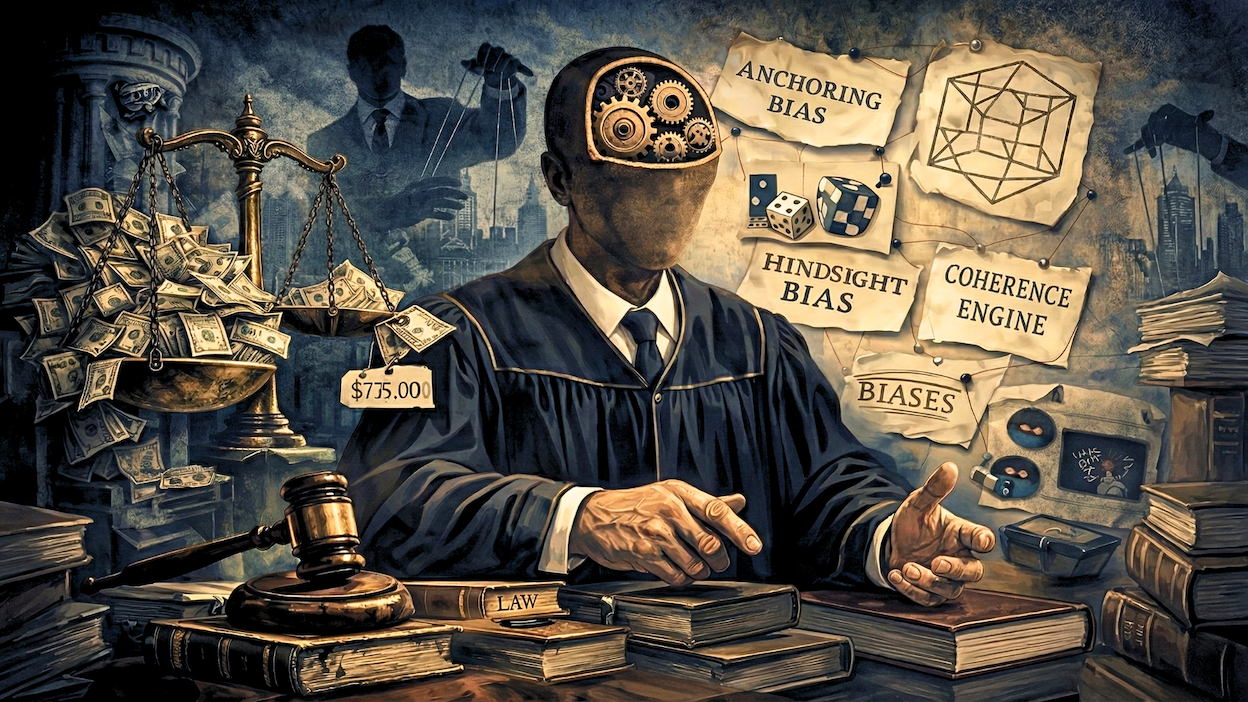
Yet mounting evidence from cognitive psychology suggests that this picture fundamentally misrepresents how judicial cognition actually operates. Judges confronted with complex, genuinely ambiguous legal questions do not encounter neutral legal materials that point to a single, self‑evident conclusion. Rather, they navigate what psychologists term a “dilemma set”, a cognitively chaotic landscape in which inferences pull in contradictory directions, competing interpretive rules offer opposite guidance, and the legal materials themselves remain genuinely indeterminate. The transition from this initial state of profound uncertainty to the confident, coherent opinions judges ultimately issue involves systematic cognitive transformations that remain largely invisible to judicial consciousness.
This hidden cognitive work raises urgent questions for democratic governance and the rule of law. If judicial subjectivity operates beneath the threshold of conscious awareness—if the appearance of objective reasoning masks the active construction of legal meaning—then the law’s legitimacy may rest on what the evidence suggests is an illusion, one that obscures the actual mechanisms of power affecting legal outcomes.
II. Conceptual Foundations: Inference, Backing and the Dilemma Set
To understand judicial decision-making, we must first examine how the human mind constructs conclusions from complex information. Cognitive psychology defines an inference as any mental process in which reasoning transcends explicit data, generating new propositions not explicitly present in the available information. Inferences are not discrete events but building blocks that accumulate and interconnect, forming chains of reasoning that ultimately support conclusions.
Following Stephen Toulmin’s influential argumentation model, inferences require backing: deeper justifications or authorities that lend persuasive weight to intermediate steps. A judge inferring that a defendant acted “wilfully” relies not merely on surface reasoning but on backing derived from statutory language, prior judicial interpretations, legislative history, and constitutional principles. This backing transforms a raw inference into a justified proposition capable of bearing weight in argument.
In straightforward legal cases, multiple inferences and their backing align coherently, all supporting a single outcome. The judge’s cognitive task remains manageable: to organise the supporting inferences into a persuasive narrative and articulate the legal conclusion.
However, in complicated cases involving genuine legal ambiguity, the judge encounters what sources identify as a “dilemma set”: the judge’s cognitive representation encompasses all relevant arguments for the case, including profoundly contradictory ones. In a single interpretive question, the judge might encounter 23 distinct arguments drawn from 10 different authoritative sources—committee reports, statutes, and precedents—pulling toward opposite conclusions. The dilemma set is “pervaded by profound conflict”, capturing the initial state of genuine complexity and uncertainty.
The Ratzlaf case illustrates this phenomenon clearly. The central question—whether criminal liability for currency structuring required knowledge specifically that structuring itself was illegal, or merely knowledge of the reporting requirement one sought to evade—admitted no self‑evident answer from statutory language alone. The justices confronted multiple credible interpretations of “wilfully”, competing principles of statutory construction, and legislative history amenable to opposing readings. The case represented not an obvious application of clear law but a genuine dilemma set, fraught with contradiction.
III. The Coherence Maximisation Process: From Dilemma to Certainty
The psychological transformation from dilemma set to confident conclusion occurs through a process that this literature terms coherence maximisation. The human mind does not passively absorb contradictory information and then somehow mystically arrive at unified conclusions. Rather, it actively works on information, modifying inferences during decision-making to construct increasingly coherent mental models.
Crucially, research consistently demonstrates that this restructuring occurs largely outside conscious awareness. Judges do not typically notice their inferences shifting or their interpretations changing. Many struggle to recall their original assessments before the decision process began, misremembering them as consistent with their final conclusions all along. This lack of awareness is not peripheral to the phenomenon; it is central to its operation. The absence of conscious recognition that cognitive restructuring has occurred preserves the subjective experience that legal materials themselves remained unchanged and objective throughout the process—that the judge was constrained by law rather than constraining law through interpretation.
The cognitive mechanisms underlying this transformation merit careful examination. Rather than involving neat linear calculation, coherence maximisation operates through what psychologists term connectionist systems and mental‑model building. Judges appear to construct tentative mental models representing legal propositions and their inferential linkages. They then test these models mentally for coherence, asking whether the narrative “holds up” logically. They retain or revise model components to increase overall coherence.
Judges, however, do not maintain a single model. Instead, they develop competing models for each potential outcome: one for ruling in favour of the plaintiff and one for ruling in favour of the defendant. Their attention literally oscillates between these alternatives, much like the famous Necker cube optical illusion, which can be perceived as facing two different directions but resists simultaneous clear perception of both orientations. When attention focuses on one model, its supporting arguments become overwhelmingly salient and coherent, while arguments supporting the alternative fade into the background.
This oscillation continues until some stopping criterion is satisfied: maximal coherence is achieved, time constraints impose limits, or a sufficient level of coherence feels intuitively adequate (what psychologists term “satisficing”). Crucially, the judge is unaware that two competing models are being tested, that attention is oscillating between them, or that arguments are being suppressed or foregrounded depending on which model currently occupies focal attention.
IV. Cognitive Restructuring Mechanisms: Gatekeeping, Bolstering and Rule Selection
The research identifies three primary mechanisms through which judges unconsciously restructure conflicting information to construct coherence: gatekeeping, bolstering, and rule selection. These mechanisms deserve detailed examination, both for their cognitive mechanics and their implications for legal reasoning.
A. Gatekeeping
Gatekeeping involves selectively including or excluding certain propositions, arguments, or facts from consideration. It extends to framing the case itself, presenting the legal narrative in a particular light from the outset. The mechanism operates actively but unconsciously, determining which information enters the coherent model being constructed.
In Ratzlaf, gatekeeping functioned distinctly in the majority and dissenting opinions. The majority downplayed or omitted details about Ratzlaf’s active steps in arranging the structuring, portraying him more passively. This framing made it more plausible to argue that he lacked the specific criminal knowledge the majority insisted was required. The dissent highlighted these very active steps, constructing a narrative of someone clearly aware of legal evasion. Both sides selectively included excerpts from legislative reports to support their views while ignoring contradictory passages they knew existed.
The gatekeeping mechanism is not unique to Ratzlaf. It operates across adjudication more generally, with courts choosing which facts to highlight, which precedents to foreground, and which legal materials to address. What appears in opinions as a natural selection of relevant materials often reflects unconscious gatekeeping that has already determined the coherent narrative the court will support.
B. Bolstering
Bolstering operates more subtly than gatekeeping. Rather than wholesale inclusion or exclusion, it involves emphasising certain features of arguments or evidence while deemphasising others. The underlying propositions remain present but are reinterpreted to better fit the emerging narrative.
Judge Benjamin Cardozo, a distinguished jurist, candidly acknowledged this phenomenon, noting that “a judge must permit himself a certain margin of misstatement”, a formulation that speaks to precisely this kind of subtle reshaping. Legal scholar Carl Lewellyn documented 64 distinct techniques judges employ to handle precedent, ranging from faithfully following prior cases to expanding, distinguishing, avoiding, or effectively overruling them. This interpretive flexibility is built into the system itself.
In Ratzlaf, both majority and dissent examined the same 1986 Senate report but interpreted it quite differently. They bolstered their respective readings by focusing on different phrases, debating grammatical significance, and emphasising or deemphasising particular language. The same text, with distinct emphases, produced opposite conclusions.
Bolstering is perhaps more difficult to police than gatekeeping because it operates on the surface, presenting the appearance of consistency: the same materials remain present, merely reinterpreted. Yet the mechanism remains fundamentally transformative, subtly reshaping how legal materials are perceived so as to support the desired conclusion.
C. Rule Selection
When multiple interpretive rules or principles could plausibly apply to a legal question, judges engage in what researchers identify as rule selection. The system of statutory interpretation includes numerous canons of construction that can point in opposite directions. Lewellyn famously identified 28 pairs of opposing canons—“thrust and parry rules”, he called them—such that for almost any interpretive principle a judge might invoke, an opposing principle exists to justify contrary results.
This redundancy is not accidental. It reflects the genuine ambiguity embedded in language, statute, and precedent. The problem for judicial decision-making is that, when confronted with contradictory potential rules, judges effectively choose which rules will be salient to the case, which will be dismissed as inapplicable, and which will be given decisive weight.
In Ratzlaf, the majority argued for contextual interpretation, examining the law’s broader purpose and policy objectives. The dissent championed textual interpretation, adhering strictly to statutory language. Both are recognised, defensible approaches within legal reasoning. Yet rule selection determined which approach became dispositive, thus determining the case’s outcome.
Rule selection demonstrates how multiple legitimate interpretive methodologies can coexist within the law, while the choice between them—often made unconsciously—determines substantive results. The available rules do not constrain decision-making to a single outcome; instead, they provide a repertoire from which judges effectively select, with significant implications for those whose interests depend on the result.
V. The Illusion of Objectivity: Unconscious Processes and Subjective Certainty
Having examined these restructuring mechanisms in isolation, we can now consider their collective significance: judges operate under what the research terms an “illusion of objectivity”.
The illusion functions as follows. Judges, through unconscious processes of coherence maximisation, actively modify inferences, selectively gate information, reinterpret arguments, and choose interpretive rules. Yet they experience this process as the constrained application of objective law. They feel bound by legal materials they perceive as fixed and external. The subjective experience of constraint persists even though conscious awareness of the transformative mental work is absent.
This illusion is not cynical fraud or deliberate deception. Judges are typically unaware that gatekeeping, bolstering, or rule selection is occurring. They genuinely experience their decisions as resulting from the law’s requirements rather than from their own cognitive restructuring. When asked how they reached a difficult decision, judges often resort to describing a “hunch”: not a random guess, but what they experience as a genuine, intuitive flash of understanding in which the correct answer crystallises out of the confusion.
William James captured this phenomenon when he observed that “when the conclusion is there, we have always forgotten most of the steps preceding its attainment”. Judge Hutchison described it as “that intuitive flash of understanding, which makes the jump, spark a connection between question and decision”. Justice Cardozo employed the metaphor of “clarity emerging like the fog lifting from the obscured problem”.
These are honest, candid descriptions of judges’ subjective experience. The conclusion does feel obvious. The answer does feel discovered rather than made. And this subjective certainty is psychologically genuine; it reflects the judge’s coherent mental model, unconsciously constructed. The illusion, then, is not that judges are deliberately dissembling but that they can experience profound subjective certainty about conclusions constructed through processes they neither recognise nor control.
The consequence, however, is profound. Judicial opinions present themselves as snapshots of objective reasoning—polished, logical, structured presentations of law. They are not, in fact, diaries of the oscillating, contradictory decision process. They are the final image of the coherent mental model after the unconscious restructuring has been completed. The opinion articulates reasons the judge now considers best support the decision.
Often, there is even a post‑decision rationalisation process. Once the choice is made, judges or their clerks may actively seek additional precedents, stronger quotations, or authoritative texts to further bolster the chosen conclusion—what the sources term “padding”. The final opinion appears even more coherent, almost inevitable, and singularly correct. Opinions then “champion [the chosen model’s] arguments and actively ignore, downplay, or refuse the arguments that supported the rejected alternative model”.
This selective focus contributes to the confident, sometimes unshakeable tone in judicial writing. The deep discrepancy between competing models, the intense conflict of the initial dilemma set, is never really confronted simultaneously in the written opinion. The judge perceives only one side of the Necker cube clearly. The rejected alternative recedes from view, along with all the arguments that supported it.
VI. Implications for Legal Theory and the Rule of Law
These psychological findings bear directly on longstanding theoretical debates in legal scholarship and on fundamental questions regarding the legitimacy of judicial power in democratic systems.
The traditional debate has opposed legal formalism—the view that judges discover law through logic and constraint applied to fixed legal materials—to legal realism, which argues that judges actively create law through choices reflecting political values and policy preferences. This psychological model suggests that the theoretical landscape requires reconsideration.
The evidence indicates that judges genuinely experience themselves as constrained by law. They truly feel that the answer emerges from legal materials, not from their own creative choices. Yet this subjective experience of constraint coexists with the objective fact that unconscious processes of information selection, interpretive modification, and rule choice have shaped the legal materials themselves into their current coherent form.
Judges are neither pure formalists discovering objective law nor bare realists imposing personal preferences with cynical disregard for legal materials. Instead, they are engaged in a complex cognitive process in which law and judgment interpenetrate. The judge’s mind does not passively receive law; it actively constructs coherent legal meaning from ambiguous materials. Yet the judge experiences this construction as a discovery of pre‑existing law.
The subjective experience of objectivity, therefore, is neither false consciousness nor deliberate deception. It is a genuine psychological artefact of achieving cognitive coherence. The law feels clear and constraining once the mind has done the work to make it so.
This analysis carries profound implications for the rule of law. If judicial decisions emerge from unconscious cognitive processes, if the appearance of objective reasoning masks active information restructuring, and if judges themselves remain largely unaware of the mechanisms driving their choices, then the transparency essential to democratic accountability becomes compromised.
The rule of law requires not merely the neutral application of existing law but the capacity of affected parties, higher courts, and the public to understand and critically evaluate the genuine reasoning processes underlying judicial decisions. If the critical processes are unconscious—if the mechanisms are invisible even to judges themselves—then the transparency required for legitimate judicial authority is undermined.
Furthermore, the selective presentation of arguments in final opinions, combined with the post‑decision rationalisation process, means that opinions themselves may be systematically misleading about the factual bases for decisions. They present selected coherent arguments while omitting the competing considerations that actually influenced the judge’s oscillating reasoning.
This is not to suggest that opinions are worthless. As the sources acknowledge, “the judge’s private need for internal consistency aligns pretty well with the public need for a justifiable, consistent legal ruling”. The reasons given in opinions reflect what became coherent for the judge and typically correspond to legitimate considerations courts ought to address.
However, knowing that opinions are produced through selective presentation and post‑hoc rationalisation should inform how we interpret them. They are not transparent windows into judicial reasoning but carefully constructed narratives that may obscure as much as they reveal.
VII. Systemic Implications: Gatekeeping, Power and Corruption
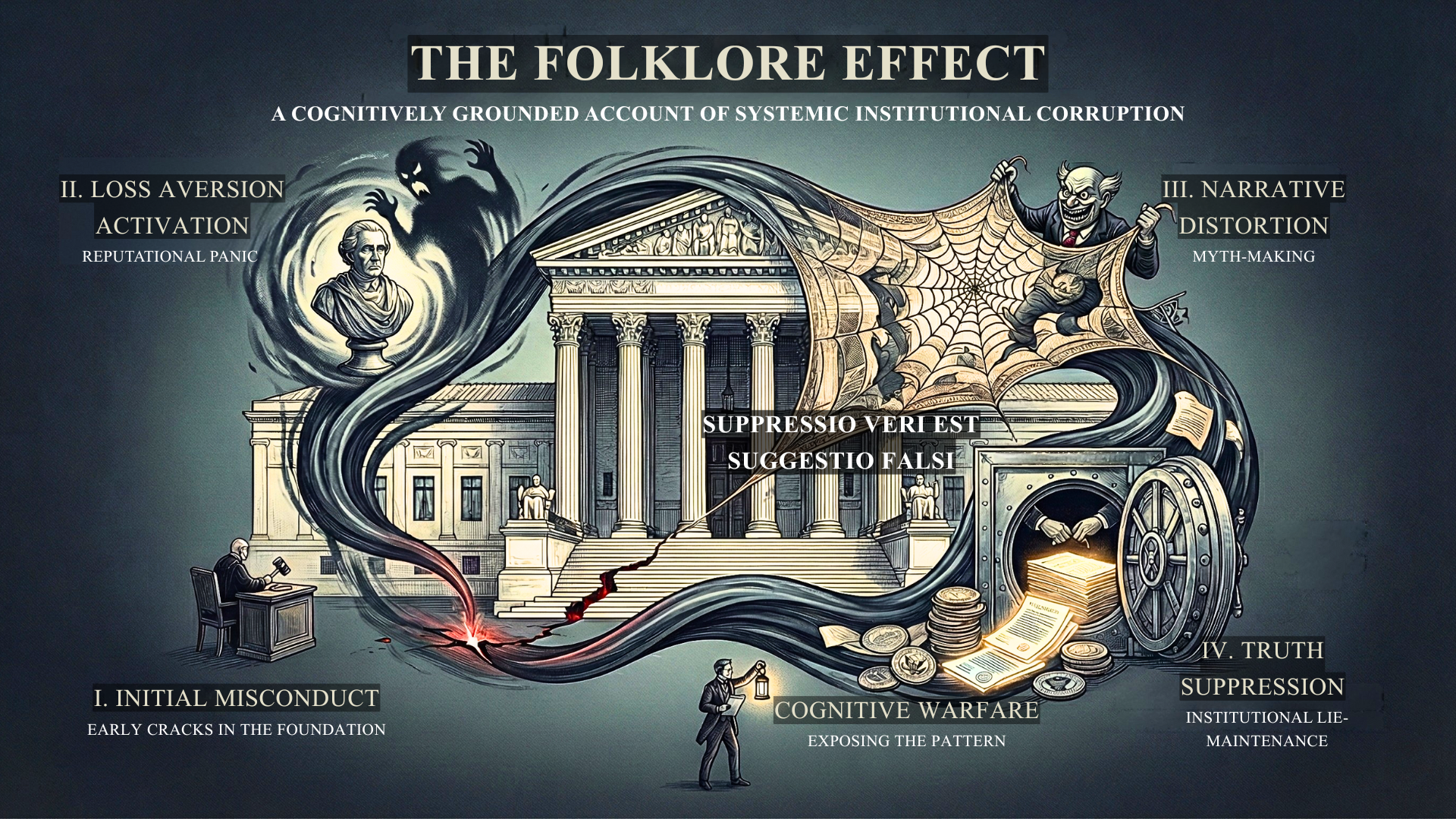
While the research presented does not explicitly address systemic corruption, its implications for how power operates through judicial institutions are significant and troubling.
If gatekeeping functions unconsciously, judges may systematically exclude specific perspectives, facts, or arguments from consideration without recognising that they are doing so. This raises the possibility that institutional structures, professional socialisation, or implicit biases may predispose judges toward particular gatekeeping patterns—patterns that advantage some interests while disadvantaging others—yet do so beneath the level of conscious recognition or explicit deliberation.
Similarly, rule selection among competing canons of interpretation may not be random. If specific interpretive traditions align with particular ideological commitments, then judges who favour those traditions will systematically produce outcomes consistent with those commitments, yet experience their choices as simply applying the law’s requirements.
The illusion of objectivity becomes particularly concerning in this context. If systemic biases shape judicial decisions through unconscious cognitive mechanisms, and if judges experience their decisions as constrained by law rather than shaped by bias, then the very processes that should provide accountability—judicial opinions articulating reasoning—may serve instead to obscure systemic distortions.
Moreover, the lack of conscious awareness of cognitive restructuring mechanisms means that judges themselves cannot easily identify or correct for potential biases. They lack introspective access to the processes determining their decisions. While implicit‑bias training and similar interventions aim to address unconscious processes, research suggests that merely knowing such mechanisms exist may be insufficient to overcome them, particularly when they are deeply embedded in normal cognitive functioning and legal practice.
VIII. Reformative Considerations
If the illusion of objectivity represents a genuine structural feature of judicial cognition, what reforms might address the resulting risks to legal accountability and the legitimacy of the rule of law?
First, enhanced epistemic awareness among judges themselves might prove valuable. If judges understood that coherence maximisation, gatekeeping, bolstering, and rule selection operate unconsciously to structure their reasoning, they might engage in more deliberate, explicit examination of these processes. Recognising that competing models are being unconsciously tested and oscillated between might encourage judges to hold both models in mind more explicitly, testing their conclusions against alternatives rather than allowing the defeated model to fade from view.
Second, procedural reforms might enhance transparency about the genuine considerations judges entertained. Rather than presenting only the chosen model’s arguments, opinions might explicitly acknowledge competing considerations and explain why they were ultimately rejected. This would transform opinions from coherent narratives that minimise apparent conflict into more transparent accounts of genuine deliberation.
Third, institutional structures might be reformed to reduce the likelihood that unconscious gatekeeping follows systematic patterns. Diverse judicial panels, requirements for explicit consideration of rejected alternatives, and appellate review processes that specifically examine whether gatekeeping has systematically excluded important considerations might all reduce the risk that unconscious mechanisms produce systematic distortion.
Fourth, legal interpretation itself might be reformed to reduce the interpretive flexibility that enables rule selection among competing canons. While complete elimination of interpretive discretion is impossible given language’s inherent ambiguity, reforms might narrow the range of defensible interpretations or establish explicit hierarchies of interpretive rules, reducing the space within which unconscious choice can operate.
Finally, greater public and scholarly awareness of these cognitive mechanisms might inform how legal reasoning is taught, discussed, and evaluated. If legal professionals understood that objectivity in the formalist sense is unattainable, they might instead focus on transparency, explicit engagement with competing considerations, and candid acknowledgment of the choices involved in statutory and constitutional interpretation.
IX. Conclusion
The illusion of objectivity reveals a fundamental tension within judicial decision-making. Judges engage in complex cognitive processes that actively transform ambiguous legal materials into coherent conclusions—processes occurring largely outside conscious awareness. Yet judges experience themselves as constrained by law, discovering rather than making legal meaning. This subjective experience of objectivity is neither false consciousness nor deliberate deception; it is a genuine psychological artefact of the construction of cognitive coherence.
However, this psychological fact has profound implications for legal accountability and the rule of law. If judicial decisions emerge from unconscious restructuring of information, and if judges themselves cannot fully explain the mechanisms driving their conclusions, then the transparency supposedly required by democratic accountability becomes compromised. The judicial opinions that are meant to justify decisions and enable appellate and public evaluation may obscure as much as they reveal.
Moreover, if unconscious cognitive mechanisms can operate systematically—if gatekeeping, bolstering, and rule selection can reflect institutional biases and ideological commitments while remaining invisible to those engaged in them—then the risk of judicial power functioning as a mechanism of systemic corruption becomes real. Power may operate through law, not despite law’s apparent objectivity, but precisely because of the illusion that law constrains judicial choice.
The evidence does not suggest that judges are typically corrupt in the conventional sense. Rather, it indicates that corruption can operate through the normal cognitive functioning of well‑intentioned judges operating within existing legal and institutional structures.
Recognition of these mechanisms does not necessarily call for abandoning the judicial process, but it does call for reform. Enhanced transparency about the genuine considerations judges entertain, procedural changes requiring explicit engagement with competing models, institutional structures that reduce the likelihood of systematic bias in gatekeeping and rule selection, and candid acknowledgment of the interpretive choices involved in legal reasoning might preserve the legitimacy of judicial authority while reducing the risks posed by unconscious cognitive processes operating beneath the threshold of accountability.
The law feels clear once the mind has done the work to make it so. Our challenge is to ensure that this clarifying work is performed transparently, with full awareness of the choices involved, and with genuine accountability to those whose interests depend on its outcomes.