





Executive Summary
Public confidence in the judiciary is a foundational pillar of the rule of law in any democratic society. Where citizens trust that courts will adjudicate matters impartially and in accordance with law, they are more likely to accept judicial decisions, submit their disputes to formal legal processes, and regard the constitutional order as legitimate. Conversely, eroding judicial confidence can destabilise democratic governance, undermine voluntary compliance with the law, and encourage resort to extra-legal means of dispute resolution.
This report synthesises data from the most authoritative international surveys and indices—including the Gallup World Poll, the OECD Survey on Drivers of Trust in Public Institutions (2024 results), the World Justice Project Rule of Law Index (2025 edition), Afrobarometer, and national surveys from the jurisdictions under study—to present a comprehensive picture of public confidence in the judiciary across seven major Common law jurisdictions: Australia, the United Kingdom, the United States, New Zealand, Canada, India, and South Africa.
The principal findings are sobering. While the judiciary typically enjoys higher public trust than legislatures or the executive across the OECD, confidence levels vary widely between common-law jurisdictions. The United States has experienced the most precipitous decline in judicial confidence of any advanced democracy, falling 24 percentage points in the Gallup World Poll between 2020 and 2024 to just 35 per cent. The United Kingdom saw a sharp 12-point drop in a single year (2025), bringing confidence to 57 per cent. Australia, while appearing moderate on international survey instruments, reveals a substantially more concerning picture when domestic surveys are examined: one nationally reported survey in 2024 found that only 30 per cent of Australians had faith in the courts and justice system, with specific concerns about the bail system, perceived sentencing leniency, and court delays. Canada and New Zealand maintain moderate confidence levels, though these too face emerging pressures. India retains comparatively high institutional trust in its judiciary, though concerns about delays and case backlogs persist. South Africa presents the most concerning trajectory among the jurisdictions studied, with trust in the courts declining substantially over the past decade amidst perceptions of corruption and state capture.
The World Justice Project’s 2025 Rule of Law Index confirms the broader trend: 68 per cent of countries worldwide experienced declines in the rule of law in 2025, with judicial independence under particular pressure from executive overreach. This report examines the drivers of these trends, their implications for democratic governance, and their significance for the general public and the rule of law.
Public confidence in the judiciary is a foundational pillar of the rule of law in any democratic society. When citizens trust that courts will adjudicate matters impartially and in accordance with law, they are more likely to accept judicial decisions, submit their disputes to formal legal processes, and regard the constitutional order as legitimate. Conversely, eroding confidence in the judiciary can destabilise democratic governance, weaken voluntary compliance with the law, and encourage recourse to extra-legal means of dispute resolution.
This report synthesises data from the most authoritative international surveys and indices—including the Gallup World Poll, the OECD Survey on Drivers of Trust in Public Institutions (2024 results), the World Justice Project Rule of Law Index (2025 edition), Afrobarometer, and national surveys from the jurisdictions under study—to present a comprehensive picture of public confidence in the judiciary across seven major Common law jurisdictions: Australia, the United Kingdom, the United States, New Zealand, Canada, India, and South Africa.
The principal findings are sobering. Although the judiciary typically enjoys higher public trust than legislatures or the executive across the OECD, confidence levels vary widely between common-law jurisdictions. The United States has experienced the steepest decline in judicial confidence of any advanced democracy, falling 24 percentage points in the Gallup World Poll between 2020 and 2024 to just 35 per cent. The United Kingdom recorded a sharp 12‑point drop in a single year (2025), bringing confidence down to 57 per cent. Australia, while appearing moderate on international survey instruments, reveals a substantially more concerning picture when domestic surveys are examined: one nationally reported survey in 2024 found that only 30 per cent of Australians had faith in the courts and justice system, with particular concern about the bail system, perceived sentencing leniency, and court delays. Canada and New Zealand maintain moderate confidence levels, though these too face emerging pressures. India retains comparatively high institutional trust in its judiciary, albeit with persistent concerns about delays and case backlogs. South Africa presents the most troubling trajectory among the jurisdictions studied, with trust in the courts declining substantially over the past decade amid perceptions of corruption and state capture.
The World Justice Project’s 2025 Rule of Law Index confirms the broader trend: 68 per cent of countries worldwide experienced declines in the rule of law in 2025, with judicial independence under particular pressure from executive overreach. This report examines the drivers of these trends, their implications for democratic governance, and their significance for the general public and the rule of law.
1. Introduction: Why Judicial Confidence Matters
The concept of public confidence in the judiciary occupies a distinctive place in legal and political theory. Unlike confidence in the executive or the legislature, which may wax and wane with partisan political fortunes, confidence in the courts is understood to reflect something deeper: the citizen’s belief that there exists a neutral arbiter capable of holding all persons and institutions, including government itself, accountable to law. As the eminent constitutional theorist Alexander Hamilton observed in Federalist No. 78, the judiciary possesses “neither FORCE nor WILL, but merely judgment,” and accordingly depends for its authority upon the sustained confidence of the people.
In Common law jurisdictions, this dependency is particularly acute. The Common law tradition vests judges with significant law-making authority through the doctrine of precedent, requires the exercise of broad discretionary powers in sentencing and the development of equitable remedies, and—in countries with constitutional bills of rights—empowers courts to invalidate legislative and executive action. The legitimacy of these formidable powers rests not on democratic elections (judges in most common-law countries are appointed, not elected) but on the perception that judicial decision-making is governed by legal principle, procedural fairness, and independence from political pressure.
The erosion of public confidence in the judiciary, therefore, carries consequences that extend well beyond public opinion polling. Declining trust may manifest in reduced voluntary compliance with court orders, legislative efforts to curtail judicial power (so-called “court-curbing” measures), political attacks on individual judges, difficulty in recruiting and retaining qualified judicial officers, and ultimately the weakening of constitutional constraints on government power. As the OECD observed in its 2024 Trust Survey report, the judicial system, together with the police, consistently ranks as the most trusted public institution across its 30 member countries surveyed, with 54 per cent of respondents expressing high or moderately high trust. Yet this aggregate figure conceals wide variation, with trust ranging from above 75 per cent in Nordic countries to below 35 per cent in others.
This report proceeds as follows. Part 2 sets out the methodological framework, identifying the principal surveys and indices upon which the analysis relies. Part 3 presents a jurisdiction-by-jurisdiction survey of current confidence levels and trends. Part 4 analyses the major root causes and events underpinning the observed trends. Part 5 draws together comparative insights and discusses the implications for the rule of law.
2. Methodological Framework and Data Sources
This report draws upon the following principal data sources, each of which employs rigorous sampling methodology and is widely recognised in the academic and policy literature:
2.1. Gallup World Poll
The Gallup World Poll surveys approximately 1,000 adults (aged 15 and older) annually in over 150 countries and territories, using either telephone or face-to-face interviews. It has tracked confidence in the judicial system continuously since 2006. The standard question asks respondents whether they have confidence in “the judicial system and courts” in their country. Results are reported as a percentage expressing confidence, with margins of sampling error typically ranging from ±2.2 to ±4.9 percentage points at the 95 per cent confidence level.
2.2. OECD Survey on Drivers of Trust in Public Institutions
The OECD Trust Survey was conducted in 30 OECD countries in October–November 2023, with nearly 60,000 responses representative of each country’s adult population. Trust is measured on a 0–10 scale, with responses of 6–10 classified as “high or moderately high” trust. The 2024 results publication represents the second wave, enabling comparison with the inaugural 2021 survey across the 20 countries that participated in both rounds.
2.3. World Justice Project Rule of Law Index
The WJP Rule of Law Index, published annually since 2009, covers 143 countries and jurisdictions (2025 edition). It draws on over 215,000 household surveys and 4,100 surveys of legal practitioners and experts. Scores range from 0 to 1 across eight factors, including the Civil Justice and Criminal Justice sub-indices, which incorporate measures of court independence, accessibility, and freedom from improper government influence.
2.4. National and Regional Surveys
In addition to these international instruments, this report draws upon jurisdiction-specific surveys including: the Australian National University’s 2025 Election Monitoring Survey Series and the Trust and Satisfaction in Australian Democracy Survey (2023); the UK Judicial Attitude Survey (2024), conducted by the UCL Judicial Institute; Statistics Canada’s General Social Survey and Survey Series on People and their Communities; the New Zealand Crime and Victims Survey Public Perceptions Module (Cycle 7, 2024); India’s National Election Studies and the Indian Human Development Survey; the South African Reconciliation Barometer (Institute for Justice and Reconciliation); and Afrobarometer Round 9 surveys for Africa including South Africa. For the United States, additional reliance is placed upon the Annenberg Public Policy Centre’s longitudinal trust surveys, the AP-NORC Centre for Public Affairs Research polls, and the National Centre for State Courts’ annual State of the State Courts poll.
3. Jurisdiction-by-Jurisdiction Analysis
3.1. United States of America
The United States presents the most dramatic case of declining judicial confidence among advanced democracies. According to the Gallup World Poll, confidence in the American judicial system fell from approximately 59 per cent in 2020 to just 35 per cent in 2024—a 24 percentage-point decline in four years. This represents one of the steepest drops Gallup has measured globally on this metric; only countries experiencing severe political disorder (Myanmar during its return to military rule, Venezuela amid deep economic and political turmoil, and Syria during the onset of civil war) have recorded comparably sharp declines over similar timeframes.
This erosion has been profoundly partisan. Trust among Democrats in the Supreme Court specifically fell 25 points between 2021 and 2022, spanning the Dobbs v Jackson Women’s Health Organisation decision that overturned Roe v Wade’s constitutional protections for abortion. Democratic confidence in the Supreme Court recovered slightly to 34 per cent in 2023, then declined again to 24 per cent in 2024. Republican confidence moved in the opposite direction, rising from 61 per cent in 2021 to 71 per cent in 2024.
The Annenberg Public Policy Centre’s longitudinal surveys provide further granularity. In March 2025, 59 per cent of Americans reported having little or no trust in the Supreme Court to operate in the best interests of “people like you,” up from 55 per cent in May 2024 and representing a dramatic deterioration from 2005, when 75 per cent expressed high or moderate trust. The AP-NORC Centre’s July 2025 survey found that while confidence had recovered modestly (to 67 per cent expressing at least some confidence), 38 per cent believed the Supreme Court held too much power.
The resulting 20-point gap between U.S. judicial confidence and the OECD median in 2024 was the largest in the Gallup trend dating to 2006. A G7 comparative analysis by Gallup found that by 2023, the United States was statistically tied with Italy as the G7 country with the least public faith in its judiciary—a remarkable reversal from its historically higher position. The WJP Rule of Law Index 2025 ranked the United States 27th out of 143 countries overall, slipping one position from the previous year.
3.2. United Kingdom
The United Kingdom has experienced a significant recent decline in judicial confidence, and, according to Gallup World Poll data published in December 2025, 57 per cent of UK adults expressed confidence in the judicial system and courts in 2025—a 12-percentage-point drop from 2024 (69 per cent). This represented the largest single-year decline on record for the UK and the first time trust in either the courts or police had fallen by more than 10 points in a single year.
Several converging factors underpin this decline. The Crown Court case backlog exceeded 73,000 cases by September 2024, with the magistrates’ court backlog exceeding 300,000. Court closures, crumbling infrastructure, and unreliable technology have compounded delays. The 2024 UK Judicial Attitude Survey, conducted by the UCL Judicial Institute with a 94 per cent response rate among salaried judges, found that 39 per cent of judges expressed concern for their personal safety in court (up from 27 per cent in 2022). Nearly 60 per cent of judges believed they were less respected by the public than two years previously. The proportion of salaried judges intending to leave the judiciary within five years rose from 23 per cent (approximately 400 judges) in 2014 to 39 per cent (approximately 681 judges) in 2024.
The OECD Trust Survey (2023 data) found that UK trust in the courts and the judicial system stood at approximately 54 per cent on a 0–10 scale, broadly in line with the OECD average. However, the judiciary has become increasingly politicised in public discourse. The Gallup data revealed a widening gap in judicial confidence between those who approve and those who disapprove of the country’s leadership, reaching its largest extent in a decade by 2025. Controversies over proposed sentencing guidelines that would have made ethnicity and faith greater factors in determining jail terms, subsequently abandoned, further fuelled political contention.
3.3. Australia
Australia presents a more complex and concerning picture than aggregate international surveys initially suggest. While international instruments place Australian judicial confidence at or near OECD averages, domestic surveys focused specifically on the courts and the criminal justice system reveal substantially lower and, in some measures, strikingly low levels of public faith.
International Survey Data
The OECD Trust Survey (2023 data, published 2024) found that Australians placed trust in the courts and the judicial system at levels broadly comparable to those in other OECD countries, and notably higher than in the national government. Separately, the Gallup World Poll has consistently shown Australian confidence in the judiciary hovering around 49–55 per cent in recent years. The Australian National University’s 2025 Election Monitoring Survey Series (Wave 4, May 2025, 3,720 respondents) found a moderate but statistically significant increase in trust in the judiciary following the May 2025 federal election, as part of a broader “democracy bounce” effect. Satisfaction with democracy reached 73.3 per cent in May 2025, up from 67.1 per cent in March/April 2025.
Domestic Survey Data: A More Concerning Picture
However, domestically focused surveys paint a considerably darker picture. A nationally reported survey in mid‑2024 found that only 30 per cent of Australians expressed faith in the courts and justice system, with the bail system identified as the primary factor driving public dissatisfaction. The finding attracted widespread media commentary, including from prominent broadcaster Tom Elliott, who described judges as “the dumbest smart people you will ever meet”—a characterisation that, while polemical, captures a strand of populist sentiment about perceived judicial remoteness from community values.
The What Australia Thinks analysis of criminal justice confidence data found that only around 48 per cent of Australians express confidence in the courts specifically (51.1 per cent of men and 45.4 per cent of women), a figure notably lower than confidence in the police (approximately 76 per cent for both genders). The analysis confirmed that Australians trust the police considerably more as they age, with confidence ranging from 63.5 per cent among 25–34‑year‑olds to 84 per cent for those aged 65 and over. The comparatively low standing of courts relative to police is consistent with the pattern documented across Common law jurisdictions, but the gap in Australia is particularly pronounced.
Research from the Australian Institute of Criminology, drawing on the Australian Survey of Social Attitudes, found confidence levels in specific aspects of the criminal justice system ranging from as low as 30 per cent (for dealing with cases promptly) to as high as 75 per cent (for respecting the rights of the accused). A separate 2025 survey of 1,000 Australians by the independent research agency Insightfully, conducted on behalf of the Australian Rule of Law Institute, found that 55 per cent of Australians rated the legal system as “good” or “very good”—a figure the Institute characterised as disappointingly low for a country whose legal system is expected to be at the forefront internationally. Academic research by Professors Roach Anleu and Mack has further established that Australians place a high value on the importance of courts while simultaneously reporting generally low confidence in the court system—a disjuncture that the researchers warn presents a profound challenge to Australia’s social fabric and legal integrity.
Peer‑reviewed comparative research published in the journal Psychology, Crime and Law confirms that Australians tend to have lower institutional trust in legal institutions than citizens of several other comparable countries, including, on some measures, the United States. This research found particularly low confidence in the courts’ capacity to impose appropriate punishment, with representative samples consistently revealing that a majority of Australians believe sentences are too lenient. The perception of judicial leniency is a persistent theme in Australian public discourse and has been identified by researchers as a significant driver of diminished confidence in the judiciary.
Sentencing Perceptions and the Bail System
The bail system has emerged as a focal point of public disquiet across Australian States and Territories, particularly in the context of high-profile violent offences committed by persons on bail. In Victoria, the Bail Amendment Act 2023 (commenced March 2024) represented an attempt to address disproportionate remand rates—particularly affecting Aboriginal young people, 97.6 per cent of whom in detention were on remand and yet to receive a conviction—while also responding to public concern about the perceived inadequacy of bail conditions. In New South Wales, BOCSAR data shows that the proportion of defendants refused bail at finalisation rose from 7.5 per cent in 2023 to 9.2 per cent in 2024, while defended hearings in the Local Court took 275 days to finalise in 2024, 28 days longer than in 2020. District Court trials took 834 days to finalise, 109 days longer than in 2020.
The NSW Bureau of Crime Statistics and Research’s public confidence surveys have consistently found that respondents who are more confident in the courts tend to be male, younger, and resident in metropolitan areas. In contrast, those with direct experience of the court system frequently report lower confidence. Critically, research from both the Australian Institute of Criminology and the NSW Sentencing Council has demonstrated that people who know more about actual crime trends, court outcomes, and sentencing practices have higher levels of confidence—suggesting that public dissatisfaction is driven, at least in part, by misperceptions amplified by media coverage.
Broader Institutional and Democratic Context
The Scanlon Foundation Research Institute’s 2024 Mapping Social Cohesion Report found that trust in government continued to decline, with the Scanlon-Monash Index of social cohesion remaining below its long-term average. The Report for 2025 confirmed that the index remained unchanged from 2023 to 2024. Data from the Australian Bureau of Statistics showed that in 2024, only 33 per cent of adults believed the Federal Government could be trusted to do the right thing all or most of the time, down from 44 per cent in 2021. The Lowy Institute’s 2025 Poll found that while 74 per cent of Australians say democracy is preferable to any other form of government (a record high), fewer than 44 per cent of those aged 18–24 agreed, and trust in institutions has continued to wane among younger Australians.
The Australian Law Reform Commission’s inquiry into judicial impartiality in federal courts found that community perceptions of bias—whether relating to gender, cultural background, or family violence—were significant concerns, and recommended reforms to appointment processes, judicial education, and the establishment of an independent body to handle complaints against federal judicial officers. Former Chief Justice Bathurst of New South Wales has emphasised that the judiciary cannot afford to be complacent in maintaining public trust, noting that minority groups are demonstrably less trusting of the courts and that the legitimacy of judicial authority depends on sustained public confidence.
Chief Justice Gageler’s 2025 State of the Australian Judicature address, delivered at the Australian Legal Convention in November 2025, catalogued systemic concerns including judicial well-being and stress, the quality of legal education, and the need for coordinated governance across Commonwealth, State and Territory courts. The Australian Government’s 2023–2024 Trust in Australian Public Services survey found 58 per cent of Australians expressing confidence in public services—the third consecutive year of stable levels—though this measure captures government services broadly, not the judiciary specifically.
3.4. Canada
Canada’s judicial system has historically enjoyed moderate public confidence, though recent data suggest emerging fragility. The OECD Trust Survey (2023 data) found that 62 per cent of Canadians expressed high or moderately high trust in courts and the judicial system—above the OECD average of 54 per cent and higher than trust in the federal government (49 per cent).
Statistics Canada’s Survey Series on People and their Communities (2022–2023) found that about 51 per cent of Canadians reported confidence in the justice system and courts, a decline from the 57 per cent reported in the 2013 General Social Survey on Social Identity. The Department of Justice’s 2023 National Justice Survey provided further detail: only 47 per cent of respondents were moderately to very confident that the family justice system is fair to all people, while 55 per cent were moderately to very confident that it is accessible to all.
Significant demographic disparities persist. Aboriginal peoples were 15 percentage points less likely than non-Aboriginal Canadians to express confidence in the justice system (43 per cent compared to 58 per cent), reflecting the overrepresentation of Indigenous peoples in the correctional system. Black Canadians born in Canada reported notably lower confidence in police (32 per cent), and Japanese Canadians reported lower confidence in the courts (36 per cent) compared to the non-racialised, non-Indigenous population (49 per cent). Conversely, many immigrant groups, particularly recent arrivals, reported higher confidence than the Canadian-born population.
An academic analysis published in Policy Options in August 2023 identified emerging partisan divergence, with Conservative supporters appearing to have less confidence in the courts than supporters of other parties. Those with direct court experience reported lower confidence than those without—a finding attributed to the cost, stress, and delays associated with court proceedings. Chief Justice Richard Wagner has publicly acknowledged that, in his view, access to justice has become a privilege of the wealthy.
3.5. New Zealand
New Zealand’s judiciary benefits from the country’s consistently high rankings in international governance indices. The WJP Rule of Law Index 2025 ranked New Zealand 5th out of 143 countries globally. Transparency International’s 2024 Corruption Perceptions Index scored New Zealand at 83 out of 100, and the 2025 Global Peace Index ranked it 3rd in the world.
The New Zealand Crime and Victims Survey’s Public Perceptions Module (Cycle 7, 2024)—the first comprehensive survey of its kind in New Zealand, interviewing approximately 6,500 people between October 2023 and October 2024—found that 78 per cent of New Zealanders had at least some trust in the justice system, with 45 per cent reporting high trust. Trust in the justice system varied across demographic groups, with victims of crime reporting notably lower trust than the general population. Forty per cent had high confidence in the effectiveness of the criminal justice system, while 47 per cent had high confidence in its fairness.
Notwithstanding these broadly positive indicators, New Zealand faces significant operational challenges. Chief Justice Helen Winkelmann’s 2024 Annual Report documented delays, a shortage of judges, and limited courtroom capacity across the country. The government’s 2024 decision to cancel legal aid funding for cultural reports—which had supported the District Court’s Te Ao Mārama initiative for solution-focused judging—was a source of controversy. The Royal Commission of Inquiry into Abuse in State and Faith-Based Care, reporting in July 2024, identified significant barriers to justice for survivors and described how the justice system had failed to protect vulnerable populations. The Māori population, which is significantly overrepresented in the criminal justice system, presents particular concerns: 42 per cent of Māori who were in State care as children ended up in prison as adults.
3.6. India
India presents a paradoxical picture: comparatively high levels of expressed trust in the judiciary coexist with profound structural challenges to the delivery of justice. Academic research using National Election Studies data has found “remarkably high levels of trust and confidence in the Indian judiciary across socio-demographic factors,” consistent over multiple time periods. The Gallup World Poll has historically recorded Indian judicial confidence levels well above the global median. In 2023, the Poll found that 82 per cent of Indians expressed confidence in their national government and 88 per cent in financial institutions—both of which were among the highest figures recorded globally.
The Indian Supreme Court’s high-profile decisions in 2024, including the landmark ruling permitting sub-classification within Scheduled Castes and the quashing of the remission of convicts in the Bilkis Bano case, were widely characterised as reinforcing the judiciary’s credibility as a guardian of constitutional values. The Court’s willingness to hold both executive and private actors accountable through public interest litigation has historically bolstered its standing.
However, significant concerns persist. Case pendency at the Supreme Court continued to increase, with approximately 2,300 more pending cases at the close of 2024 than at the end of 2023. The lower courts face even more severe backlogs, with tens of millions of pending cases across the system. Commentators have noted that the collegium system of judicial appointments, which lacks transparency, and instances of perceived executive deference in politically sensitive cases, risk eroding the institutional legitimacy that the judiciary currently enjoys. The Indian Human Development Survey data (2004–05 and 2011–12) confirmed high household confidence in courts, but also revealed that such confidence was shaped more by perceptions of institutional competence than by caste or religious identity.
3.7. South Africa
South Africa presents the most concerning trajectory among the Common law jurisdictions studied. Despite a constitutional framework that vests significant powers in an independent judiciary, public trust in the courts has declined markedly over the past decade.
Afrobarometer data (Round 9, 2021/2023) found that a majority of South Africans (53 per cent) trust their courts “just a little” or “not at all,” compared to 43 per cent who trust them “somewhat” or “a lot.” This represents a significant decline from earlier surveys. In Afrobarometer’s tracking since 2011/2013, South Africa experienced a 33 percentage-point decline in trust across key institutions, among the largest drops on the African continent. The Institute for Justice and Reconciliation’s South African Reconciliation Barometer (SARB) found that trust in the Constitutional Court stood at just 38 per cent in 2023, dramatically lower than its peak of 65 per cent in 2011.
The Afrobarometer data further revealed that almost one in three South Africans (32 per cent) believed “most or all” judges and magistrates to be corrupt. Perceived corruption in government generally stood at 89 per cent in earlier Gallup data. However, earlier Gallup World Poll data had also shown that 80 per cent of South Africans trusted the Supreme Court and judges to be autonomous in their decisions—one of the highest figures in sub-Saharan Africa—suggesting that while perceptions of corruption are significant, there remains a reservoir of trust in the principle of judicial independence.
State Capture and the political turbulence of the Zuma presidency have been identified as central drivers of the decline in institutional trust. Justice Maya, now President of the Supreme Court of Appeal, identified declining public trust in the judiciary as requiring “urgent attention” during her JSC interview for the Chief Justice position in 2022. The poor and the uneducated are significantly more likely to report distrust of the courts—a finding of particular concern given that these groups are a primary target of access-to-justice initiatives.
4. Comparative Data Summary
The following table summarises key confidence indicators drawn from the surveys discussed above. Figures reflect the most recent available data from each source and employ different methodologies; direct cross-survey comparison should therefore be undertaken with appropriate caution.
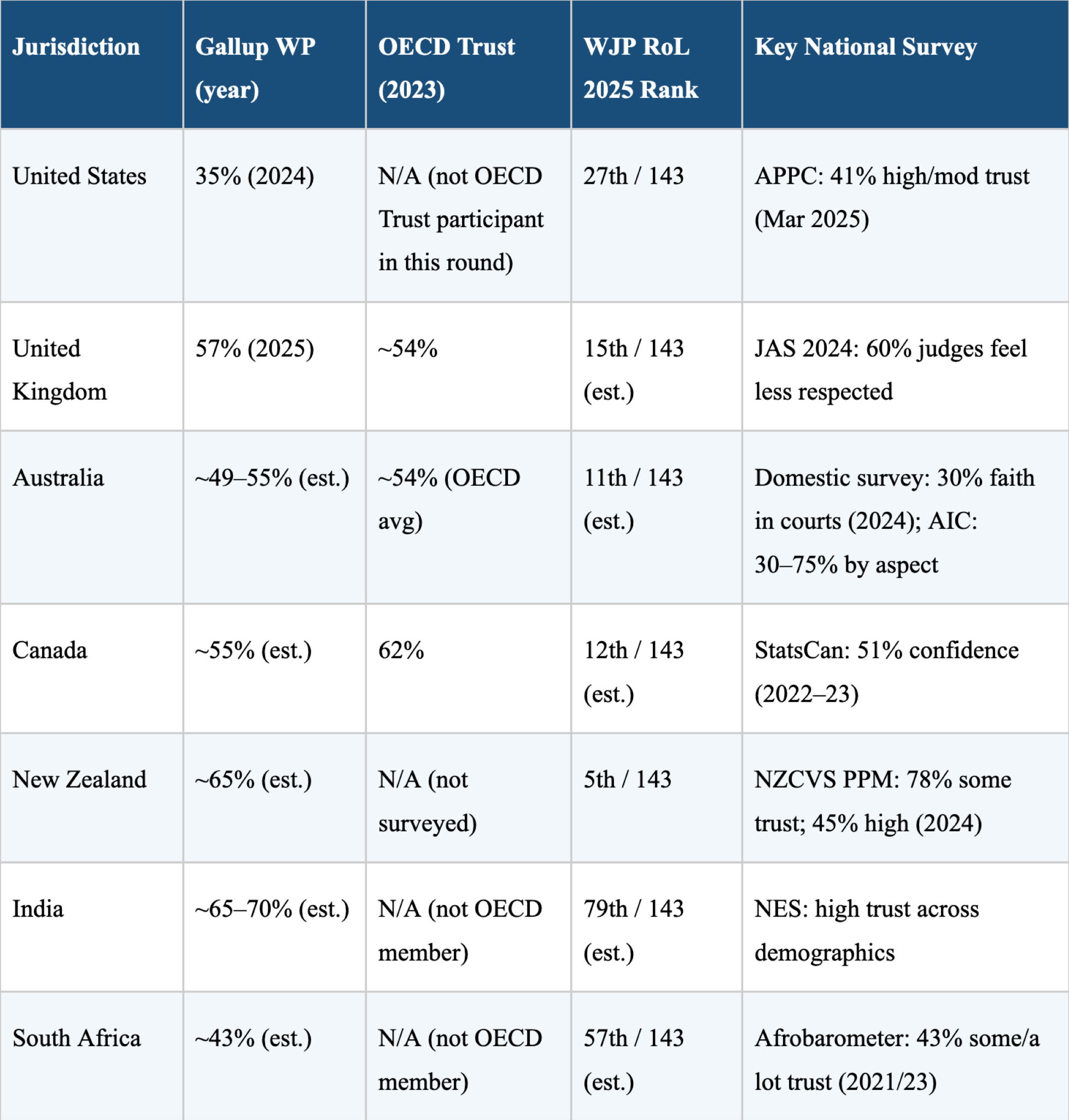
Note: Gallup WP = Gallup World Poll; OECD Trust = OECD Survey on Drivers of Trust in Public Institutions; WJP RoL = World Justice Project Rule of Law Index. Figures marked “est.” are estimates based on available data ranges. Methodologies differ across surveys.
5. Root Causes, Key Events, and Structural Drivers
5.1. Politicisation of the Judiciary
The single most significant driver of declining judicial confidence across Common law jurisdictions is the real or perceived politicisation of judicial institutions. In the United States, the hyper-partisan nature of Supreme Court appointments, the landmark reversal of Roe v Wade in Dobbs (2022), and the multiple criminal indictments of a former president have transformed the judiciary into a site of intense partisan contestation. The Gallup data demonstrate that judicial confidence now correlates more strongly with political affiliation than at any point in the polling record. The Annenberg Public Policy Centre found that a majority of Americans believe justices shape the law to fit their own ideologies rather than serving as an independent check on other branches.
In the United Kingdom, political actors have increasingly deployed rhetoric about “two-tier” justice, while proposed sentencing guidelines that incorporate ethnicity and faith have provoked significant controversy. In Canada, Conservative supporters report lower confidence in the judiciary than supporters of other parties. In South Africa, the Zuma presidency’s open defiance of court orders and the politicisation of the Chief Justice appointment process have been damaging. Even in India, where the judiciary retains comparatively strong support, the opaque collegium system of appointments attracts criticism from both those who perceive it as insufficiently democratic and those who fear creeping executive influence.
5.2. Court Backlogs, Delays, and Access to Justice
Across virtually every jurisdiction studied, court backlogs and systemic delays are major structural drivers of declining confidence. In the United Kingdom, the Crown Court backlog exceeded 73,000 cases by September 2024, with total outstanding cases across all courts estimated at 653,000 as of March 2024. In New Zealand, Chief Justice Winkelmann’s 2024 Annual Report identified delays, judicial shortages, and limited courtroom capacity as persistent problems. In India, tens of millions of cases remain pending across the court system. In Canada, delays became so severe that the Supreme Court, in R v Jordan (2016), imposed presumptive ceilings on trial processing times.
The consequences for public confidence are direct. Research consistently shows that citizens with direct experience of the court system report lower confidence than those without such experience. This pattern, documented in both Canadian and New Zealand surveys, suggests that the operational performance of courts is a key mediating factor between institutional design and public trust.
5.3. Judicial Independence Under Pressure from Executive Overreach
The WJP Rule of Law Index 2025 documents a global pattern of judicial independence being eroded by executive overreach. Indicators measuring whether the judiciary limits executive power and whether civil and criminal justice are free from improper government influence declined in 61 per cent, 67 per cent, and 62 per cent of countries, respectively. This pattern is evident in several Common law jurisdictions. In South Africa, the decade‑long struggle over State Capture directly implicated the executive’s relationship with the judiciary. In the United States, constitutional confrontations between the executive and the courts have intensified, with public polling indicating that a significant minority of Americans is willing to countenance executive non‑compliance with judicial rulings.
5.4. Socio-Economic and Demographic Disparities
Every jurisdiction studied reveals significant disparities in judicial confidence along socio‑economic, racial, and demographic lines. In Australia, research by the Scanlon Foundation shows that financial well‑being is among the factors most strongly associated with institutional trust. In Canada, Aboriginal peoples express markedly lower confidence in the justice system. In South Africa, people who are poor or have limited formal education report the lowest levels of trust. In New Zealand, Māori are significantly overrepresented in the justice system and face documented barriers to access. In the United States, perceptions of racial and gender bias within the system are widespread.
These disparities have important implications for the rule of law. Where the populations most likely to encounter the justice system as defendants or litigants are also those with the least confidence in its fairness, the risk of perceived illegitimacy is magnified. The gap between the law’s promise of equal justice and its experienced reality then becomes a source of systemic tension.
5.5. Judicial Wellbeing and Institutional Capacity
An emerging body of evidence links judicial well‑being to institutional capacity and, by extension, to public confidence. The 2024 UK Judicial Attitude Survey found that 46 per cent of Senior Coroners reported “extreme stress,” as did approximately one‑third of Circuit Judges and High Court family judges. Contributing factors included excessive workload, fears for personal safety, poor building conditions, and reduced earnings relative to legal practice. Over the past decade, the proportion of salaried judges in England and Wales intending to leave the judiciary within five years has nearly doubled. The Australian Chief Justice’s 2025 address similarly identified judicial stress and well‑being as a systemic concern. In March 2025, the United Nations adopted a Declaration on Judicial Wellbeing, explicitly recognising the connection between judicial welfare and the effective administration of justice.
5.6. The Information Environment: Disinformation and Social Media
The OECD’s 2024 Trust Survey report identifies the evolving information environment—characterised by polarising content and disinformation—as a significant driver of the broader decline in institutional trust. Although this phenomenon is not unique to the judiciary, courts are particularly vulnerable because norms of judicial restraint and sub judice rules constrain their communication with the public. The Pew Research Centre’s 2024 survey across 24 countries found that relatively few people identified judicial reform as a top priority for improving democracy, but the notable exceptions (especially Israel and, to a lesser extent, Poland) illustrate how judicial institutions can become lightning rods for wider societal polarisation.
6. Global Context: The WJP Rule of Law Index 2025
The World Justice Project’s 2025 Rule of Law Index provides essential global context. It found that 68 per cent of the 143 countries surveyed experienced declines in the rule of law in 2025, a marked acceleration from 57 per cent in the previous year. The top‑ranked countries were Denmark, Norway, Finland, Sweden, and New Zealand, while the lowest‑ranked were Venezuela, Afghanistan, Cambodia, Haiti, and Nicaragua.
Most significantly for the present analysis, the Index shows that judiciaries worldwide are losing ground to executive overreach. Civil justice has weakened in 68 per cent of countries, reflecting longer delays, less effective alternatives to the courts, and greater government interference. The WJP’s Executive Director described a “sharp reversal” in recent years, with deteriorating countries declining at approximately twice the rate of improving countries. These findings underscore that the trends observed in the Common law jurisdictions analysed in this report are not isolated phenomena but part of a broader global regression in the rule of law.
Global median confidence in the judicial system, as measured by the Gallup World Poll, reached 53 per cent in 2024—the first time since tracking began in 2006 that median confidence ratings for all five institutional measures (military, banks, judicial system, honesty of elections, and national government) simultaneously exceeded 50 per cent. This aggregate improvement, however, masks profound divergences between regions and individual countries.
7. Implications for the General Public and the Rule of Law
The findings of this report have significant implications for both the general public and the institutional architecture of the rule of law in common-law jurisdictions.
First, declining judicial confidence is not merely a matter of public opinion; it has concrete institutional consequences. Where confidence falls, legislatures face incentives to curtail judicial power, executive actors may feel emboldened to defy or circumvent judicial rulings, and the recruitment and retention of high‑calibre judicial officers become more difficult. The UK’s looming judicial recruitment and retention crisis, documented in the 2024 Judicial Attitude Survey, is illustrative: a judiciary that cannot attract and retain the best legal minds will inevitably deliver a diminished quality of justice, further eroding public trust in a self‑reinforcing cycle.
Second, the pronounced partisan and demographic stratification of judicial confidence observed across these jurisdictions threatens the universalist premise on which the rule of law rests. If confidence in the courts becomes a proxy for political affiliation—as it increasingly has in the United States—the judiciary’s capacity to serve as a neutral arbiter is undermined, not necessarily in fact but in perception, which, in a democratic system, may be equally consequential.
Third, the persistent gap between the confidence levels of disadvantaged populations (including Indigenous peoples, racial minorities, the poor, and the less educated) and those of the general population raises fundamental questions about equal justice. To the extent that these populations experience the justice system as costly, inaccessible, discriminatory, or ineffective, their lower confidence is not a misperception to be remedied by public relations but a rational response to institutional shortcomings that demand structural reform.
Fourth, operational performance matters profoundly. Evidence from multiple jurisdictions demonstrates that court backlogs, delays, failures of physical infrastructure, and chronic under‑resourcing are primary drivers of declining confidence. Adequate investment in the justice system—in judicial appointments, courtroom capacity, technology, and legal aid—is not merely an administrative concern but a prerequisite for maintaining the rule of law. As the New Zealand Ministry of Justice’s Long‑Term Insights Briefing 2025 observed, case disposal almost keeps pace with new filings, but not quite, leading to a gradual accumulation of backlogs over time.
Fifth, judicial transparency and civic education emerge as partial but important remedial strategies. Research from Canada demonstrates that citizens with greater knowledge of the courts express higher confidence in them. Supreme Court outreach programmes in New Zealand, the public release of bench books, and judicial education initiatives may all contribute to a more informed public understanding of the judicial role. However, transparency alone cannot compensate for structural deficiencies in resources, independence, and equity.
8. Conclusion
The data assembled in this report present a complex and often troubling picture of public confidence in the judiciary across the Common law world. The United States stands out for both the magnitude and speed of its decline in judicial confidence—an unprecedented development among advanced democracies that has injected intense partisan polarisation into perceptions of the courts, with implications for their institutional legitimacy. The United Kingdom has experienced a sharp, sudden drop in confidence, driven by operational failures and emerging politicisation. South Africa faces a sustained erosion of trust linked to corruption, inequality, and political interference. Australia, while appearing moderate on international survey instruments, reveals a substantially more troubling picture domestically: one major survey records only 30 per cent public faith in the courts, alongside persistent perceptions of sentencing leniency, growing dissatisfaction with the bail system, and academic evidence of a paradoxical disjuncture between the high value Australians place on courts and their low confidence in how those courts operate. Canada and New Zealand maintain comparatively robust confidence levels but face structural challenges—including access‑to‑justice deficits, demographic disparities, and resource constraints—that could, if left unaddressed, produce trajectories similar to those observed elsewhere. India retains high expressed confidence but confronts enormous case backlogs and institutional pressures that test the durability of that trust.
The World Justice Project’s 2025 finding that 68 per cent of countries experienced rule‑of‑law declines, with judiciaries globally losing ground to executive overreach, places these jurisdiction‑specific findings in a sobering global context. The rule of law is not self‑sustaining; it requires continuous investment, vigilant protection of judicial independence, and a genuine commitment to equal access to justice. As the Gallup World Poll data illustrate, public confidence in the judiciary can be lost far more rapidly than it can be built.
For the general public, the core message is this: courts are not merely institutions for lawyers and litigants. They are the means by which the promise of equal justice under law is either realised or denied. Public confidence in the judiciary is both a barometer of the health of constitutional democracy and a precondition for its survival. The trends documented in this report demand the sustained attention of governments, the legal profession, civil society, and citizens alike.
References and Principal Sources
Afrobarometer (2024). Across Africa, Public Trust in Key Institutions and Leaders is Weakening. Afrobarometer Dispatch No. 891.
Afrobarometer (2022). South Africans’ Trust in Institutions and Representatives. Afrobarometer Dispatch No. 474.
Annenberg Public Policy Centre (2025). Most Americans Support Checks on Presidential Power—University of Pennsylvania.
AP-NORC Centre for Public Affairs Research (2024). Confidence in the Supreme Court Remains Low.
AP-NORC Centre for Public Affairs Research (2025). Confidence in the Supreme Court is Increasing, But So Are Concerns Over Its Power.
Australian Bureau of Statistics (2025). Trust in National Government. Measuring What Matters.
Australian Institute of Criminology (2009). Confidence in the Criminal Justice System. Trends and Issues in Crime and Criminal Justice No. 387.
Australian Law Reform Commission (2021). Judicial Impartiality: Judicial Bias and Public Confidence – The Importance of Good Data.
Australian National University (2025). 2025 Election Monitoring Survey Series, Wave 4.
Australian Public Service Commission (2024). Trust and Satisfaction in Australian Democracy Survey Report.
Australian Public Service Commission (2024). Trust in Australian Public Services: 2024 Annual Report.
Bar Standards Board (2025). Ipsos Poll on Public Awareness of the Bar and the Bar Standards Board for 2025.
Corder, H. (2020). Public Confidence in the Judiciary: A South African Perspective. UNODC.
Gageler, S. (2025). The State of the Australian Judicature in 2025. High Court of Australia.
Gageler, S. (2025). The State of the Australian Judicature in 2025. High Court of Australia.
Gallup World Poll (2024–2025). Confidence in Institutions Data. Gallup, Inc.
Gallup (2025). Americans Pass Judgment on Their Courts.
Gallup (2025). Britons’ Trust in Courts and Police Declines.
Gallup (2024). U.S.: Leader or Loser in the G7?
Gallup (2025). Confidence in National Institutions May Have Local Roots.
HM Courts & Tribunals Service (2025). Annual Report and Accounts 2024–25. UK Ministry of Justice.
IAALS (Institute for the Advancement of the American Legal System). Public Trust and Confidence Project.
Institute for Justice and Reconciliation (2023). SA Reconciliation Barometer 2023.
Institute for Justice and Reconciliation (2024). Trust in the Government and Its Institutions.
Ministry of Justice, New Zealand (2024). NZCVS Cycle 7: Public Perceptions of the Justice System.
Ministry of Justice, New Zealand (2025). The Future Operation of the Courts and Justice Services: Long-Term Insights Briefing.
National Centre for State Courts (2024). State of the State Courts: 2024 Public Opinion Poll Findings.
OECD (2024). Survey on Drivers of Trust in Public Institutions – 2024 Results. OECD Publishing, Paris.
OECD (2024). Survey on Drivers of Trust in Public Institutions 2024 Results – Country Notes: Australia; Canada.
O’Donnell, J., Guan, Q. & Prentice, T. (2024). Mapping Social Cohesion 2024. Scanlon Foundation Research Institute.
Pew Research Centre (2024). Views of Rule of Law Issues, Safety and Judicial Reform in 24 Countries.
Public Safety Canada (2005). Public Confidence in Criminal Justice: A Review of Recent Trends 2004–05.
Shankar, S. & Mehta, P.B. (eds.) (2019). A Qualified Hope: The Indian Supreme Court and Progressive Social Change. Cambridge University Press.
Statistics Canada (2015). Public Confidence in Canadian Institutions. GSS Social Identity 2013.
Statistics Canada (2023). Confidence in Institutions Varied Across Racialised Groups.
Statistics Canada (2024). Differences in Confidence in Public Institutions Across Generations of Canadians.
Thomas, C. (2025). 2024 UK Judicial Attitude Survey: England & Wales Courts, Coroners and UK Tribunals. UCL Judicial Institute.
Bathurst, T.F. (2022). Trust in the Judiciary—Judicial Commission of New South Wales.
Bornstein, B.H. et al. (2022). Trust in the Jury System: A Comparison of Australian and U.S. Samples. Psychology, Crime & Law 28(6).
Freiberg, A. (2021). Bridging Gaps, Not Leaping Chasms: Trust, Confidence and Sentencing Councils. International Journal for Court Administration 12(3).
Insightfully (2025). Survey on Perceptions of the Australian Legal System. Australian Rule of Law Institute.
Jones, C. & Weatherburn, D. (2010). Public Confidence in the NSW Criminal Justice System. Australian & New Zealand Journal of Criminology 43(3).
NSW Bureau of Crime Statistics and Research (2025). Criminal Courts Statistics Jan 2020 to Dec 2024.
Roach Anleu, S. & Mack, K. (2010). The Work of the Australian Judiciary: Public and Judicial Attitudes. Journal of Judicial Administration 20(1).
Roach Anleu, S., Mack, K. & Tutton, J. (2018). The Judiciary and the Public: Judicial Perceptions. Adelaide Law Review 39(1).
Sourdin, T. & Freiberg, A. (2021). Measuring Trust and Confidence in Courts. International Journal for Court Administration 12(3).
What Australia Thinks (2024). Do We Trust Our Criminal Justice System? Data Analysis.
Winkelmann, H. (2025). Chief Justice’s 2024 Annual Report. Courts of New Zealand.
World Justice Project (2025). WJP Rule of Law Index 2025. Washington, DC.