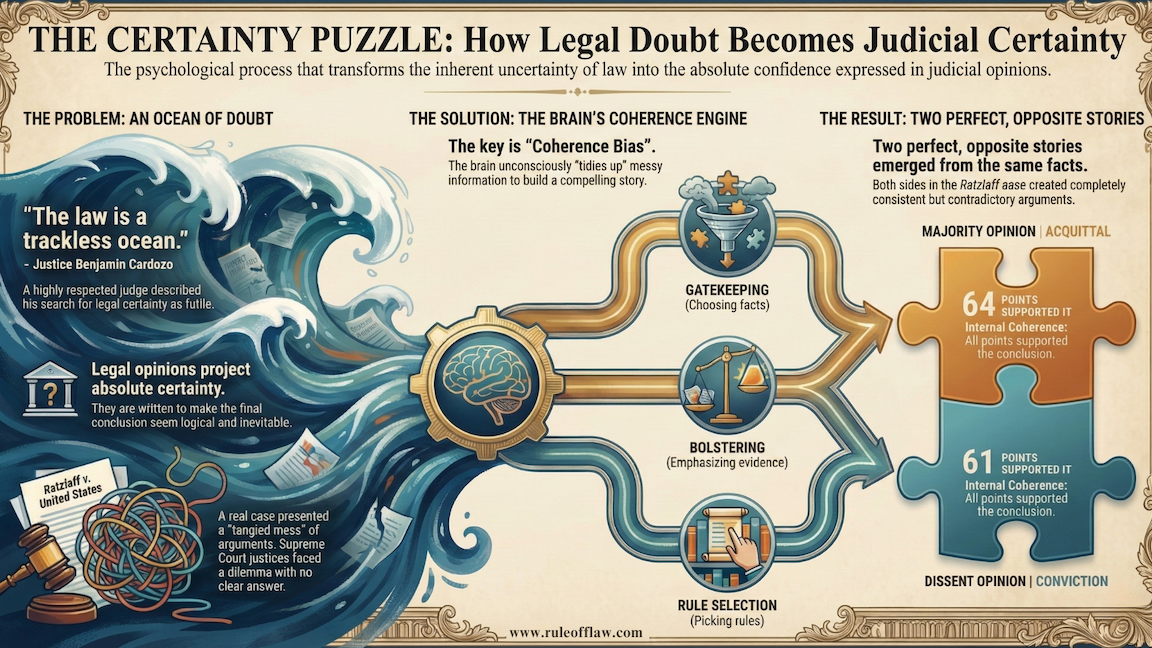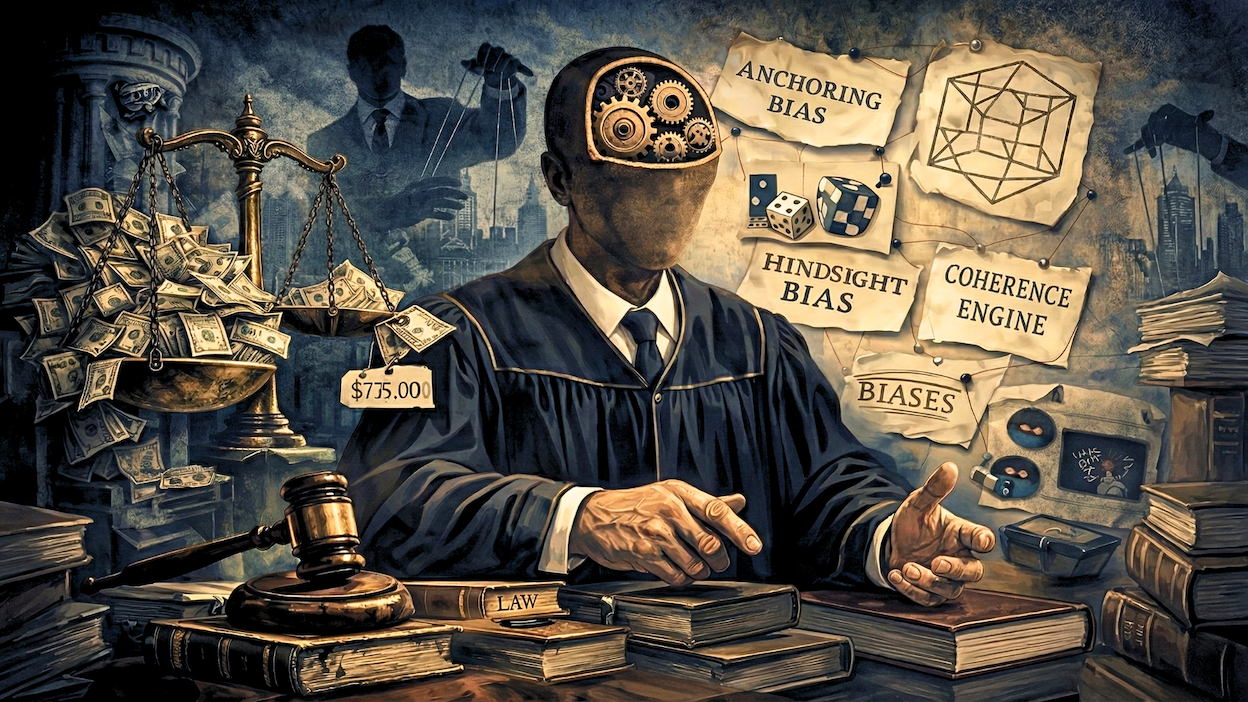





This video clip offers the clearest and most comprehensive explanation of the intellectual framework underpinning Rule O’Flaw’s work. Shivesh Kuksal weaves together behavioural economics, game theory, cognitive psychology, and dual-process neuroscience to show not merely that the judicial system is imperfect, but that its imperfections are predictable, systematic, and—critically—exploitable by those with the knowledge and incentive to do so.
Kuksal begins by outlining the disciplinary foundations of Rule O’Flaw’s analysis: behavioural economics, which reveals the gap between how people are presumed to behave and how they actually behave; game theory, which models the strategic interactions between rational and boundedly rational actors; and cognitive psychology, which explains the neurological mechanisms underlying these deviations from rationality. Together, these fields have produced what Kuksal describes as a revolution in understanding how social institutions operate in practice, rather than how they are designed to operate in theory.
The core insight is that the economic models underlying the legal system assume rational agency—that judges, jurors, and litigants make decisions by methodically weighing evidence and applying rules. Cognitive science, however, shows that people predominantly operate on instinct and heuristics, and that their capacity for rational deliberation is both genetically limited and highly sensitive to physiological state. People construct post-hoc narratives to rationalise decisions that were, in reality, driven by impulse. In Kuksal’s analysis, they are far more manipulable than they believe themselves to be—and this manipulability scales up when individuals are aggregated into institutions.
Kuksal returns to the Tel Aviv parole study as a powerful illustration, explaining in detail how the dual-process model of cognition (System One and System Two) accounts for the observed correlation between hearing timing and the likelihood of favourable outcomes. He extends this analysis to the separate neural pathways for abstract and social-justice reasoning, and to the framing effects that can be exploited to shift judicial perceptions.
He then introduces the critical and often overlooked dimension that distinguishes his analysis from conventional critiques of judicial bias: the manipulability of these cognitive limitations. The conventional understanding of judicial error treats it as random noise—a margin of error that affects both sides of a dispute roughly equally. Kuksal argues that this is dangerously naive. A sophisticated institutional actor—such as a government agency—can strategically exploit cognitive biases and physiological limitations to shift the burden of judicial error overwhelmingly onto the opposing party. The framing of charges, the timing and sequencing of evidence, and the strategic use of additional counts to signal culpability can all be calibrated to exploit the known weaknesses of judicial cognition.
He also identifies a structural failure in the dissemination of knowledge: the academics who study these phenomena remain largely confined to universities, and their findings are not systematically incorporated into the design or administration of the justice system. Rule O’Flaw’s mission, in this context, is to bridge that gap—to bring the insights of cognitive science and behavioural economics into the courtroom, both through litigation and through public education.
For the rule of law, the implications are stark. If the cognitive limitations of judges are not merely imperfections but vectors for systematic manipulation, then the principle of equality before the law is compromised at a fundamental level. The party with greater knowledge of judicial cognition—often the state—possesses a structural advantage that no amount of procedural safeguard can neutralise so long as the underlying cognitive vulnerabilities remain unacknowledged. Kuksal’s argument is that only by publicly disseminating this knowledge can citizens begin to counterbalance the inherent asymmetry—and that the failure to do so is itself an injustice.